 |
|
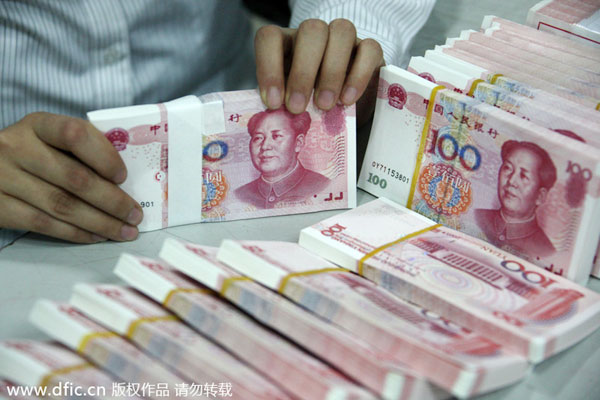
A clerk counts yuan bills at a bank in Huaibei, East China's Anhui province. [Photo/IC] |
BEIJING - China's new yuan-denominated lending in January hit 1.47 trillion yuan ($239.8 billion), up 289.9 billion yuan from one year earlier, official data showed on Friday.
M2, a broad measure of money supply that covers cash in circulation and all deposits, increased 10.8 percent year on year to 124.27 trillion yuan at the end of January, according to data released by the People's Bank of China, the central bank.
The narrow measure of money supply (M1), which covers cash in circulation plus demand deposits, rose 10.6 percent year on year to 34.81 trillion yuan.
Total private financing stood at 2.05 trillion yuan in January, down 539.4 billion yuan from a year ago.
Related story: Yuan sees increased volatility as depreciation pressure mounts, by Xinhua
BEIJING - The Chinese currency has seen sharp volatility against the US dollar this week as a strengthening dollar stokes worries of the yuan's depreciation.
The yuan continued to decline against the dollar on Wednesday with its spot exchange rate closing at 6.2480 per US dollar, down 45 basis points from Tuesday, according to data released by the China Foreign Exchange Trade System.
The rate also dropped almost 1.95 percent from the central parity rate, just short of the two-percent floatation band allowed by authorities.
On Monday, the Chinese currency sank to its lowest level in seven months by closing at 6.2542 before rebounding to 6.2435 on Tuesday.
Economists believe the Chinese currency's volatility is caused by normal fluctuations, which have been triggered by quantitative easing measures by the European Central Bank and interest rate cuts in markets such as Switzerland, Denmark, Egypt, India, Turkey and Canada.
"Some central banks are successively cutting rates to cope with rising deflation risks and lift economic momentum. These measures and particularly the ECB's bond-buying program were the direct cause of the yuan's slump," said Wen Bin, chief researcher at China Minsheng Bank.
Depreciation pressure mounts
The dollar started an upward trend in July last year against sharp falls by other major currencies, including the euro. The US Dollar Index has gained nearly 18 percent since then.
Analysts said the trend weighs negatively on the yuan's rate against the dollar, especially when a looming interest rate hike by the US Federal Reserve has led to expectations of a stronger dollar.
Taking into account an economic slowdown in China, Wen predicted the yuan, also known as the renminbi, will likely depreciate by as much as 3 percent against the dollar within the year, reaching around 6.4 per dollar.

Copyright 1995 - . All rights reserved. The content (including but not limited to text, photo, multimedia information, etc) published in this site belongs to China Daily Information Co (CDIC). Without written authorization from CDIC, such content shall not be republished or used in any form. Note: Browsers with 1024*768 or higher resolution are suggested for this site.
License for publishing multimedia online 0108263 Registration Number: 130349