 |
|
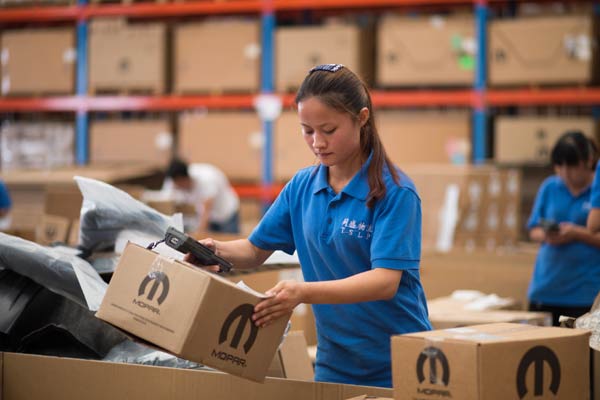
Workers pack goods at a warehouse in the China (Shanghai) Pilot Free Trade Zone. JOHANNES EISELE/AGENCE FRANCE-PRESSE |
Though weak global cues may dampen China's trade prospects in 2015, it will still maintain a healthy pace as the recent bilateral and regional trade initiatives will start bearing fruit and support the "new normal" of slower trade growth in the country, experts said.
That analysis should come in handy for policymakers as there were apprehensions for 2015, amid poor growth this year, the renminbi appreciation concerns and weak recovery in the European Union and Japan. China is set to miss its 2014 trade growth target of 7.5 percent and record its slowest growth since 2009.
"Domestic economic restructuring to favor slower, sustainable growth, coupled with poor global recovery, means that China's foreign trade will also see a 'new normal' of more moderate single digit growth going forward," says Zhang Jianping, director of the International Economic Cooperation Institute at the National Development and Reform Commission.
Despite the pessimism on trade growth, Zhang expressed confidence that China could still outpace global trade growth, revised down by the World Trade Organization to 4 percent, and developing economies' trade growth of 4.5 percent.
Li Jian, head of the foreign trade research department at the Chinese Academy of International Trade and Economic Cooperation, says global demand still remains the single most important factor for China's foreign trade.
"Since global growth is slow and demand is weak, trade prospects in 2015 do not exude much optimism. We expect to see more steady growth, like the levels seen this year," says Li.
By the end of October, China's total trade grew 3.87 percent year-on-year to $3.53 trillion, with 5.8 percent growth in exports and 1.6 percent in imports, according to the Ministry of Commerce.
Given the negative trade prospects, a stagnating European Union and the recession in Japan, many analysts believe that China will start relying more on new bilateral and regional trade partners.
Song Hong, director of the international trade department at the Chinese Academy of Social Sciences, says: "Government initiatives, such as the New Silk Road Economic Belt and the 21st Century Maritime Silk Road, Bangladesh-China-India-Myanmar economic corridor, and new free trade agreements with Australia and South Korea, will be new drivers of trade growth."
China completed its free trade agreement with South Korea on the sidelines of the APEC meeting in Beijing on Nov 10. A week later, a free trade agreement with Australia was signed during President Xi Jinping's visit to the country.
Zhang says: "China is actively promoting infrastructure connections as part of its increased cooperation in the Asia-Pacific region and along the New Silk Road, especially with high-speed rail projects. Such large infrastructure projects will drive domestic manufacturing and exports."
The Association of South East Asian Nations could be a highlight for China's foreign trade in 2015, especially with the proposal to upgrade the existing free trade agreement, says Zhang.
Trade with ASEAN, China's third-largest trade partner behind the United States and the European Union, reached $390.77 billion in October, an increase of 8.9 percent year-on-year.
The Ministry of Commerce said recently that the monetary policy of developed economies, especially the end of US Federal Reserves' bond buying scheme known as quantitative easing, is a secondary risk to economic stability in 2015. Strong US recovery and an end to the QE policy will see the dollar appreciate and capital flowing back to the US from emerging markets, the ministry said.
John Ross, senior fellow at the Chongyang Institute for Financial Studies at Renmin University, says: "If the renminbi rises in tandem with the dollar, it will add more negative pressure to China's exports and trade position."
However, Li says: "Given China's current exchange rate policy, even if the renminbi appreciates it will only be small fluctuations and hence unlikely to be a key influence on foreign trade in 2015. But the capital outflow could affect emerging economies importing from China."
Zhou Mi, a researcher at CAITEC, says a stronger US economy and dollar will present an opportunity for China to expand its export.
"Greater purchasing power of US consumers and companies will increase the demand for overseas products, benefiting countries like China that export lower technological and value-added consumer and industrial products to the United States," Zhou says.

Copyright 1995 - . All rights reserved. The content (including but not limited to text, photo, multimedia information, etc) published in this site belongs to China Daily Information Co (CDIC). Without written authorization from CDIC, such content shall not be republished or used in any form. Note: Browsers with 1024*768 or higher resolution are suggested for this site.
License for publishing multimedia online 0108263 Registration Number: 130349