 |
|
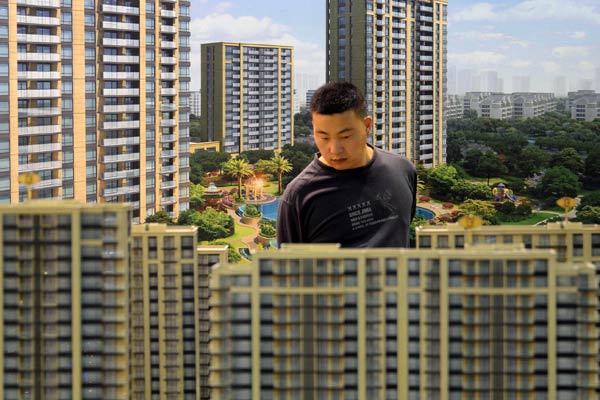
The property market's impact on China's economy goes beyond investment to an array of related industries, such as steel, cement, furnishing and home appliances. SHI JIANXUE/CHINA DAILY |
Higher exposure to sector increases risks for banks, says new S&P report
Persistent weakness in the real estate market will dent prospects for Chinese lenders due to their large exposure to the sector, global credit ratings agency Standard & Poor's Rating Services said on Tuesday.
Loans to property development and construction copanies from all sources amounted to 8.2 trillion yuan ($1.3 trillion), or 13.8 percent of the total loans, at the end of last year, the ratings agency said in a report. That compared with 7 trillion yuan, or 11.9 percent of the total loans made by commercial banks by the end of 2013.
S&P estimated the unreported portion of property-related loans by assuming that credit intensity for property investment is stable, and that reduced bank loans to the property industry-as the consequence of the government's tightening policy since 2011-were replenished by funds from the shadow banking system.
"The property market downturn is the biggest risk for the top 50 Chinese lenders that we analyzed," S&P said in its report.
What is more, the risk could be amplified as 30 to 40 percent of corporate loans in China are against property and land as collateral, S&P said, adding that a noticeable drop in, or even a flat, property valuation could significantly hinder corporate borrowers' ability to obtain fresh funds.
Chinese banks have heavily relied on collateralized lending to make loans since the early 2000s. Property and land are among the most favored forms of collateral.
In addition, the property market's impact on China's economy goes beyond property investment to an array of related industries, such as steel, cement, furnishing and home appliances, and S&P estimated their combined value accounts for 20 to 30 percent of the GDP. The overall economic slowdown hence poses a larger threat to the banking sector.
Commercial banks' non-performing loans in the third quarter rose for the 12th consecutive quarter, and the non-performing loan rate rose to 1.16 percent, up from 1.07 percent at the end of June, according to the China Banking Regulatory Commission.
Liao Qiang, senior director of S&P's financial services ratings, said even the 8.2 trillion yuan figure derived by the agency underestimated the actual scene, as many loans were used for real estate development under other names.
"For example, a State-owned industrial conglomerate may use the loans it gets to fund property development projects," Liao said.
However, S&P noted the impact of a property market downturn will vary among lenders. The big lenders are likely to be better placed to withstand the downturn than their smaller peers, and they have proportionally less exposure to financially weak developers than their small counterparts.
The CBRC does not regularly disclose banks' exact exposure to the property sector. Wang Zhaoxing, vice-chairman of the CBRC, said at a June news conference that lending to the real estate sector is "stable".
Real estate loans (to both developers and home buyers) account for about 20 percent of total bank lending, with individual mortgages representing 75 percent. The NPL ratio for mortgages is less than 1 percent, he said.

Copyright 1995 - . All rights reserved. The content (including but not limited to text, photo, multimedia information, etc) published in this site belongs to China Daily Information Co (CDIC). Without written authorization from CDIC, such content shall not be republished or used in any form. Note: Browsers with 1024*768 or higher resolution are suggested for this site.
License for publishing multimedia online 0108263 Registration Number: 130349