 |
|
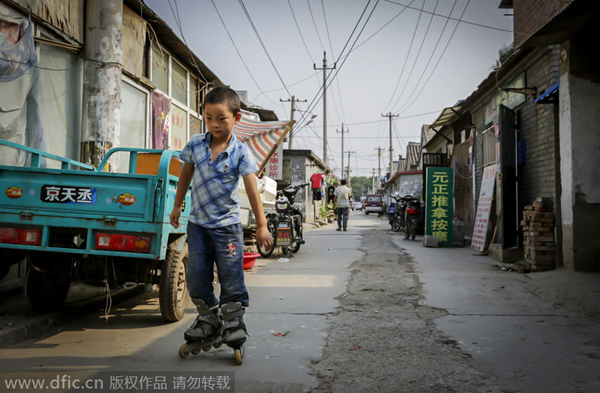
Boy play on a street in Shigezhuang village, Pingfang township, Chaoyang district, in Beijing on August 9, 2014. [Photo/IC] |
China has designated dozens of cities, provinces and counties for a program that will evaluate its new urbanization plan, which was issued in the first half of this year.
Detailed plans are being drawn up for 62 cities and counties and two provinces, Xu Lin, director-general of the department of development planning under the National Development and Reform Commission, said on Friday.
In March, China announced an urbanization plan for 2014-20 that is intended to eliminate any obstacles to urbanization and expand rural residents' access to social services and education.
The nation aims for an urbanization rate of 60 percent by 2020. The figure was 53.7 percent as of the end of last year, according to the National Bureau of Statistics.
The NDRC and 11 other ministry-level bodies are involved in designing pilot programs for the places on the list, Xu told the 2014 Urban China Initiative Annual Forum in Beijing.
A cost-sharing mechanism will be explored in these regions that will help migrant workers settle in cities and get access to social services, said Xu.
Millions of migrant workers live in cities where they don't have residence rights (hukou), which limits their families' access to social services, education and even the right to own housing in some cases.
Resettling China's rural workers into city life could cost about 650 billion yuan ($106 billion) a year, the Chinese Academy of Social Sciences, a leading State think tank, estimated last year.
Xue Lan, dean of the School of Public Policy and Management at Tsinghua University, said most local governments are under heavy fiscal pressure when it comes to providing public services.
"The one-size-fits-all public service system should be reformed to meet diversified demand for various groups," said Xue.
Xu said that diversified and sustainable financing systems need to be put in place. For projects that can generate stable long-term revenue, public-private partnerships (contractual partnerships between public and private-sector organizations) can be a major way to attract investment.
It's also important to establish a mechanism to bring debt risks under control, he said.
Land reform is the biggest challenge because multiple goals are being pursued at the same time, such as strengthening rural property rights and protecting arable land, said Xu. He added that it's necessary to improve the efficiency of government management and cut red tape.
Government bodies are working on plans to achieve the target of transferring about 100 million agricultural workers and other rural residents into cities and towns by 2020.
Xu said the previous practice of strictly limiting the size of big cities has become unrealistic, because China now has many cities with more than 1 million people.
It's unrealistic to set targets to control these cities' size, as research has demonstrated that cities with a population of 2 million to 5 million are more efficient and can achieve economies of scale, he said.
 |
 |
| China's urbanization brings world opportunities | New strategy for China's big cities |

Copyright 1995 - . All rights reserved. The content (including but not limited to text, photo, multimedia information, etc) published in this site belongs to China Daily Information Co (CDIC). Without written authorization from CDIC, such content shall not be republished or used in any form. Note: Browsers with 1024*768 or higher resolution are suggested for this site.
License for publishing multimedia online 0108263 Registration Number: 130349