The world is discussing China's economic growth along two lines. One is the immediate result, such as how much growth China should aim for in 2015. The other line is the long-term prospects, such as how much growth China can deliver in the next 20 years.
Examples of the short-term discussion include the World Bank review on China, released on Wednesday, saying the country can afford to lower its annual growth target to 7 percent in 2015, in contrast with 7.5 percent for 2014, without hurting its overall job market picture.
 |
| Chinese economy continues adjusting to "new normal" |
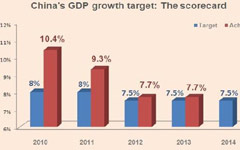 |
| Experts: GDP growth target reasonable |
Another example was an earlier forecast from the International Monetary Fund that growth would slow almost imperceptibly over the next five years to 6.3 percent.
Of the long-term line, the most noticeable example is the recent article by Harvard economists Lant Prichett and Lawrence Summers, the latter a former US Treasury secretary. The two economists' central theme is "reversion to the mean", meaning that although some countries, China being one, may have had long periods of extraordinary growth, their past performance cannot, as historically it does not, predict their future results; in the long run, all countries tend to grow around 2 percent annually.
The article suggests that if the Chinese economy takes the "reversion-to-the-mean" road, it would have lost as much as $40 trillion in economic output by 2033, compared with sustaining its growth rate of two years ago.
Yet both lines of discussion are based on similar concerns that Chinese leaders will have addressed sooner or later, and better sooner than later, and that without unleashing new dynamics from society, the country simply cannot continue the growth rate it had in the past three decades. So the biggest challenge is a political one. It is only a euphemism to call it a "structural" one. For structural imbalances on a national level can be addressed only by political means.
By the same token, all the detailed growth scenarios are only of secondary importance. The most important thing is to show, by looking at what the government is doing, what kind of growth China is generating.
If there is a system that encourages, or at least allows, both the central and local governments to pursue their development programs, there will be a higher growth rate.
But if, judging by all major national policies, there is a system that allows only the central government to pursue its goals, and for some reason all the local governments cannot go after their own initiatives, growth would be sluggish.
During the era of the planned economy, changes were reported from year to year. Whether or not they translated into true growth was beside the point. Because they were meant to serve a highly centralized system, they yielded little direct benefit in citizens' daily lives, nor did they indirectly give rise to more services.
In fact, as early as the 1960s, Chinese leaders harbored the idea of "two levels of initiatives", that is, those on both the central and local government levels. But due to the great social experimentation program at that time, local level initiatives never got much of a chance.
Right now, China is once again at a stage of great experimentation: Politically, it wants to crack down on official corruption and to strengthen the legal system like never before.
Economically, it wants to shed its previous economic model in which high growth was primarily obtained through high input, and to highlight innovation and a rise in productivity.
Socially, it wants to relocate up to 200 million rural residents to cities.
Seen independently, all of the above programs are of great help to China. But when they operate all at one time, all under less-than-lenient guidance from the central government, local initiatives would inevitably be squeezed and become less viable - at least until some new practices can be developed to bring back the "two levels of initiatives". Only then can China fully realize its society's dynamics.
The author is editor-at-large of China Daily.

Copyright 1995 - . All rights reserved. The content (including but not limited to text, photo, multimedia information, etc) published in this site belongs to China Daily Information Co (CDIC). Without written authorization from CDIC, such content shall not be republished or used in any form. Note: Browsers with 1024*768 or higher resolution are suggested for this site.
License for publishing multimedia online 0108263 Registration Number: 20100000002731