 |
|
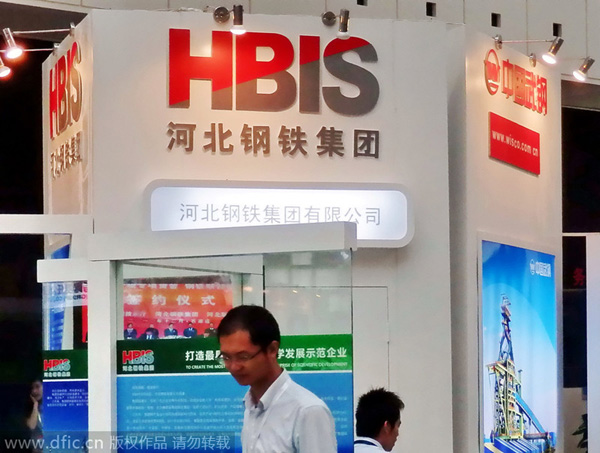
A visitor walks past the stand of HBIS (Hebei Iron and Steel Group Co Ltd) during an exhibition in Shanghai, Sept 26, 2011. [Photo/IC] |
Hebei Iron &Steel sets up mill in South Africa to circumvent dwindling demand, tough market conditions at home, reports Lyu Chang.
Although dwindling domestic demand and excess capacity have shrunk profit margins for most Chinese steelmakers, it has inspired some to tap overseas markets for sustained, long-term growth.
Hebei Iron &Steel Co, China's second-largest steelmaker by volume, however, believes that the current situation, though difficult, is something that can be overcome. "When the going gets tough, the tough get going," said company officials, adding that the proposed steel plant in South Africa would help the company offset the current problems.
Hebei, a province that surrounds Beijing, used to produce about 30 percent of the world's steel output every year. But many of the steel mills in Hebei were forced to close due to falling prices and sluggish demand. Unlike most of its peers who were waiting for a government bailout, Hebei Iron &Steel took matters in its own hands and decided to set up China's biggest overseas steel mill in South Africa.
Explaining the rationale behind the move, company officials said that despite the glut in the domestic market, the growing demand in overseas markets, particularly in Africa, which is experiencing rapid development, will help the Chinese steelmaker maintain output at current levels.
Last month, the State-owned steel company signed a deal to take a 51 percent stake in a steel venture with the Industrial Development Corp of South Africa and the China-Africa Development Fund being the minor investors. The steel mill is expected to start production in 2019 with an annual output of 5 million metric tons, said company officials.
The first phase of construction is expected to start next year with a target to produce 3 million tons of steel in 2017. The second phase of construction, which will start in 2017, targets 2 million tons of steel production.
Yu Yong, chairman of the Tangshan-based company, said it was a "rational choice" to adapt to the variable situation and face the market challenges.
"We will be able to tap domestic, overseas resources and markets as well as secure a foothold in the global production chain," he said. "It's not only part of a national 'going out' investment strategy, but also signals the start of a structural shift in the steel sector."
China's steel industry had seen rapid growth in the past decade, especially from 2008 onwards, due to a series of economic stimulus measures and cheap credit and construction contracts-a strong incentive to build more steel mills as well as preferential tax rates.
Zhu Jimin, executive vice-chairman of the China Iron and Steel Association, said domestic steel production capacity has increased from 200 million tons in 2012 to 1.1 billion tons now. That accounts for more than half of the world's steel capacity.
But with rising environmental concerns and excess capacity taking its toll on the industry, the government was left with no choice, but to cut steel output by 27 million tons this year, in addition to the 10.44 million tons cut in 2013. More bigger cuts are on the way, sources said, adding that China plans to reduce 60 million tons of steel production by 2017, and another 26 million tons by 2020. Hebei province, with a total annual production capacity of 286 million tons, intends to cut output by 30 percent.
Mi Pengqi, a steel analyst at 315.com.cn, an online bulk commodity platform, said that Hebei Iron &Steel's move comes at a time when domestic steelmakers are feeling the pressure from the government campaign on pollution and the moves to impose stringent regulations and standards. The government is not only determined to tackle the industry glut, but also move to a situation wherein the market can play a greater role in the development of the industry.
|
 |
 |
| China sees deeper iron ore price declines | Economic woes crimp steel demand |

Copyright 1995 - . All rights reserved. The content (including but not limited to text, photo, multimedia information, etc) published in this site belongs to China Daily Information Co (CDIC). Without written authorization from CDIC, such content shall not be republished or used in any form. Note: Browsers with 1024*768 or higher resolution are suggested for this site.
License for publishing multimedia online 0108263 Registration Number: 20100000002731