Jiang Siqiang has a whole list of reasons why he is not interested in shifting any of his money from the Chinese mainland's equity markets to Hong Kong.
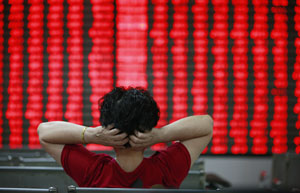
As the 67-year-old retiree sips tea and watches stock prices flicker across the screen at a brokerage in Shanghai, he ticks them off one by one. Shanghai shares tend to trade at cheaper valuations than those listed 1,224 kilometers away in the special administrative region. Hong Kong's market rules are unfamiliar, and he is also turned off by the poor track record of Chinese money managers who buy foreign shares through the Qualified Domestic Institutional Investor program.
"Even QDII funds are losing money overseas, and they are managed by experts," Jiang said at a Changjiang Securities Co outlet in Shanghai's Pudong district. "I wouldn't buy Hong Kong stocks" any time soon.
 |
 |
China, the biggest emerging economy, is counting on a successful exchange link to help liberalize its financial system, increase the role of the yuan and give its citizens more investment channels amid a slumping property market and increased risks from local wealth-management products. The program, set to start in October, allows a net 23.5 billion yuan ($3.8 billion) of daily cross-border purchases.
Yet the allure of Hong Kong shares has diminished since 2007, when a proposal allowing mainland investors to buy equities in the city, dubbed the through train, sent the benchmark Hang Seng Index up 60 percent over three months before the plan was abandoned during the global financial crisis. The new exchange link is being implemented with limits on the number of available stocks, mostly larger companies, as part of an effort to attract a stable pool of investors.
Dual-listed Chinese companies trade at a premium of about 6 percent in Hong Kong over the mainland, versus a 44 percent discount at the end of 2007, according to the Hang Seng China AH Premium index. Anhui Conch Cement Co, China's biggest producer of the building material, is 19 percent more expensive in Hong Kong than Shanghai, while the premium for China Life Insurance Co, the largest insurer, is 14 percent.
Further hurdles include the 500,000 yuan minimum account size for mainland investors to participate in the link, and the exclusion of small-cap stocks, favored by speculative traders for their high volatility, according to CLSA and Aviate Global.
"Small retail investors won't have too much interest in buying Hong Kong stocks under the program," said Wang Weijun, a strategist at Zheshang Securities Co in Shanghai.
An official at the Shanghai Stock Exchange declined to comment. Scott Sapp, a spokesman for Hong Kong Exchanges & Clearing Ltd, did not respond to phone and e-mail requests for comment.

Copyright 1995 - . All rights reserved. The content (including but not limited to text, photo, multimedia information, etc) published in this site belongs to China Daily Information Co (CDIC). Without written authorization from CDIC, such content shall not be republished or used in any form. Note: Browsers with 1024*768 or higher resolution are suggested for this site.
License for publishing multimedia online 0108263 Registration Number: 20100000002731