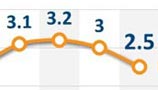
Economic data in recent months has shown meaningful improvement on the back of a series of government stimulus measures, which seem to have put a stop to China's latest slowdown, which was highlighted by first-quarter growth decelerating to an 18-month low.
 |
In July, the official manufacturing Purchasing Managers Index reached its highest level this year at 51.7. Profits of Chinese industrial companies rose 17.9 percent year-on-year in June, up sharply from an 8.9 percent rise in May, according to the National Bureau of Statistics. The bounceback came amid Beijing's policy accommodation.
In June, Chinese banks extended a stronger-than expected 1.08 trillion yuan ($175 billion) in new local-currency loans. M2, a broad measure of money supply, jumped 14.7 percent in the same month from a year earlier, which was 1.7 percentage points higher than the central bank's 13 percent annual rise target this year.
Much of the liquidity went into infrastructure investment, which served as the driving force for the recovery. According to the NBS, investment in infrastructure grew 4.4 percent in the first half from a year earlier.
"The recovery is mainly being driven by two factors: investment and external demand ... consumption played little part," Qiao Hong, chief economist, greater China at Morgan Stanley, told a news briefing last week.
That conflicts with the objectives of the nation's ongoing reforms. China's "economic miracle" of the past 30 years was largely driven by investment and exports. But that growth model has reached the point where it is no longer sustainable, given the toll it has taken on the environment and resources.
That realization prompted the central government to initiate sweeping reforms starting last year, with one key objective being increasing the role of consumption in the economy.
The slowdown this year was mainly caused by those very reforms, which include deleveraging, reining in investment and cutting overcapacity. Stimulating the economy in a way that conflicts with the reforms seems to indicate that the government's commitment to reform has waned.
China's economic reforms are at an inflection point, with many issues increasingly becoming gray rather than black and white. For China to make the leap that Japan and South Korea did, becoming a developed economy, the nation needs to have a tough mind and a strong hand.

Copyright 1995 - . All rights reserved. The content (including but not limited to text, photo, multimedia information, etc) published in this site belongs to China Daily Information Co (CDIC). Without written authorization from CDIC, such content shall not be republished or used in any form. Note: Browsers with 1024*768 or higher resolution are suggested for this site.
License for publishing multimedia online 0108263 Registration Number: 20100000002731