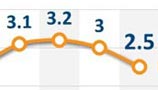
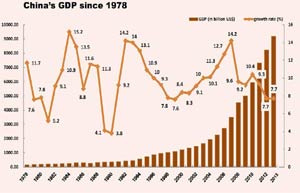
The country has got as much economic growth as it needs. Its annualized GDP growth was 7.4 percent in the first half of the year, falling short of its yearly target by a negligible 0.1 percentage point, amid ample signs that it can still attain that in the second half. So in all likelihood, China will meet its yearly growth target of 7.5 percent.
This should bolster people's confidence that China can sustain relatively high growth while making the successful transition to higher quality.
The reality, as shown by the latest figures from the National Bureau of Statistics, is contrary to the concerns circulating in the capital market earlier this year that the sustainability of China's growth would inevitably suffer as a result of the flagging export demand, limited domestic buying power, and an almost fathomless level of local government debts.
That was a time when some economists said a tumble in the growth rate was nothing to be afraid of - if not to be welcomed to convey a sense of urgency to companies that they needed to change their way from low quality and low value-added production.
It is easy to either keep piling up unsold products or to simply let unprofitable companies sink. It is much harder and riskier to try to strive for both growth and transition. But there is a bonus in doing so, because by delivering both, Chinese leaders will earn the confidence of the people and global businesses.
Politically, Beijing has the authority to make local governments restructure their debts, and can use decrees both to shut down the unwanted industrial capacity and provide incentives to the industries and projects that generate jobs and quality growth. Economically, the country still has vast discrepancies. Given the right policies, those discrepancies can become opportunities, such as the internal migration of the rural population to the cities. This unprecedented urbanization will result in a much larger consumer base for new services.
The above strategy was at work in the first half of the year, and is likely to work to an even greater extent over the next few years.
Now China has learned, and has proved to have learned well, the ways to iron out business cycles and to maintain growth despite difficulties, one can reasonably expect the second half of the year to feature more actions to facilitate the economy's transition.
 |
 |
| China's H1 growth up 7.4%, showing economic resilience |
|

Copyright 1995 - . All rights reserved. The content (including but not limited to text, photo, multimedia information, etc) published in this site belongs to China Daily Information Co (CDIC). Without written authorization from CDIC, such content shall not be republished or used in any form. Note: Browsers with 1024*768 or higher resolution are suggested for this site.
License for publishing multimedia online 0108263 Registration Number: 20100000002731