Monetary policy has been relied on to do the heavy lifting in the post global financial crisis world, and the same has been true in China. The People's Bank of China (PBOC) just announced a partial RRR cut but there is much hope that full-scale RRR cuts can ease credit conditions and arrest the slowdown in the real economy. We think such hope is misplaced – RRR is not the only or main constraint to credit expansion and credit is not the main culprit to the problems in the real economy. Don't count on RRR cuts to lift credit growth and have lasting positive impact on real economic activity.
|
 |
Should China cut RRR?
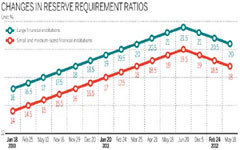
Yes. China's reserve requirement is high (19.5 percent on average, and 20 percent for large State-owned banks) and the reserves are remunerated at only 1.62 percent, below the market rate. This is essentially a tax on banks that has led to distortive behaviors such as incentivizing banks to use wealth management products and interbank deposits to fund credit expansion. So cutting RRR can reduce banks' cost and distortive behaviors, which may lead to a reduction in credit cost in the real economy.
Cutting RRR can also increase liquidity in the banking system, although using reverse repos and on-lending can achieve similar result. Indeed the PBOC has used the latter measures to ease liquidity condition in recent months, and as a result interbank rates have been kept at low levels not seen since May 2013, and marginal borrowing costs for the private sector has come down as well. Of course, liquidity released by RRR cut is more "permanent", which can help anchor expectations in the market and lead to longer-term deployment of the increased liquidity by banks.

Copyright 1995 - . All rights reserved. The content (including but not limited to text, photo, multimedia information, etc) published in this site belongs to China Daily Information Co (CDIC). Without written authorization from CDIC, such content shall not be republished or used in any form. Note: Browsers with 1024*768 or higher resolution are suggested for this site.
License for publishing multimedia online 0108263 Registration Number: 20100000002731