|
 |
|
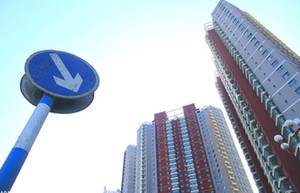
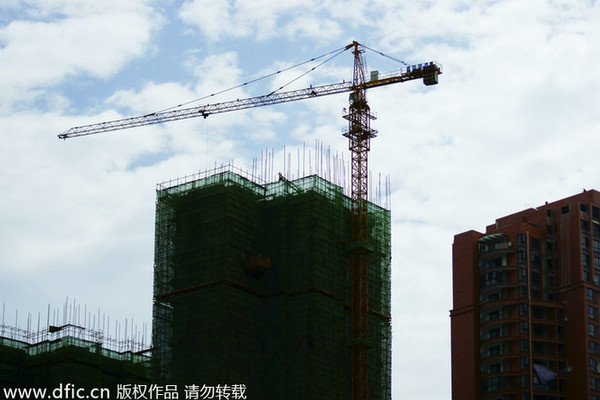
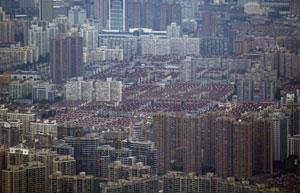
New apartments are under construction in Yichang, Hubei province. China is witnessing the phenomenon of 'ghost cities'amid excess investment in property development in recent years. Experts say a careful approach is required to create environmental sustainability. [Photo/IC] |
Getting bigger, richer doesn't solve metro center woes
An interesting theory is making the rounds. It claims to identify turning points in population scale and density where the growth of Chinese cities' sustainability will slow down or stall. The experts behind the theory are urging improvement in China's urban management and a change in the way cities are laid out with no goal beyond
|
 |
|
 |
It's difficult to improve a Chinese city's sustainability by boosting per capita GDP alone, particularly once the population exceeds 4.5 million or population density reaches 8,000 people per square kilometer, according to a recent study from the Urban China Initiative, a joint initiative of a panel of institutions, including consultancy McKinsey & Co Inc.
The Urban Sustainability Index displays positive correlations between environmental sustainability and per capita GDP, population size and density. But that's only when a city has fewer than 4.5 million residents or density of less than 8,000 people per sq km.
"Those 'turning points' in China are unique and don't hold in cities across the world," said Li Shantong, senior research fellow at the Development Research Center of the State Council.
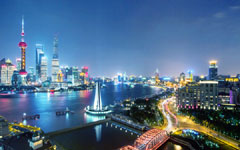
Consider Tokyo, whose density is about 14,440 people per sq km, about the same as in Shanghai. Tokyo's per capita GDP was $72,000 in 2011, five times the level in Shanghai.
But Tokyo wins out in all aspects over Shanghai, such as livability, traffic management and social security.
"These facts suggest that, for further growth of sustainability, our cities must accelerate steps to narrow the gap between them and other global cities regarding urban management capacity," Li said.
"China, on the one hand, has witnessed the absurd phenomenon of 'ghost cities' and excess investment in property development. On the other hand, it has large, densely packed cities that have scant traffic management and medical resources," said Li Xun, vice-president of the China Academy of Urban Planning and Design.
"It requires a careful approach to improve and balance (this situation) for our cities' sustainability," he added.
Urban administrators have been too obsessed with economic results, resulting in cities whose layout "drags down the pace of sustainable development", said Cao Jianhai, a professor at the Institute of Industrial Economics of the Chinese Academy of Social Sciences, a top government think tank.
"In terms of city development, Chinese municipal governments have always concentrated on maximizing interests and collecting tax revenue over social welfare and the environment," said Cao.
China's local fiscal revenue in 2013 reached 6.8 trillion yuan ($1.1 trillion), with land transfer fees accounting for almost 60 percent.
|
 |
 |

Copyright 1995 - . All rights reserved. The content (including but not limited to text, photo, multimedia information, etc) published in this site belongs to China Daily Information Co (CDIC). Without written authorization from CDIC, such content shall not be republished or used in any form. Note: Browsers with 1024*768 or higher resolution are suggested for this site.
License for publishing multimedia online 0108263 Registration Number: 20100000002731