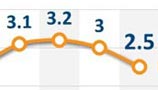
China's broad measure of money supply (M2) stood at 116.07 trillion yuan by the end of March, up 12.1 percent from a year earlier. Meanwhile, narrow measure of money supply (M1) grew 5.4 percent year-on-year to hit 32.77 trillion yuan, and money in circulation (M0) increased 5.2 percent to reach 5.83 trillion yuan from a year earlier. The M2 growth is the slowest pace in 13 years. But why has it fallen?
The unexpected drop of M2 growth rate is mainly attributable to the high base of the same period last year, when incremental total social financing stood quite high, and the authorities required that wealth management products be reflected in banks' balance sheets at that time, pushing up the base of comparison.
Meanwhile, yuan depreciation and diminishing carry trade activities have led to a fall in the country's foreign exchange purchases, a trend that is reflected in the recent trade data released by the General Administration of Customs.
The government's tightened regulation on shadow banking has also weighed on M2 growth. China's total social financing totaled 5.6 trillion yuan in the first quarter, down 9 percent from a year earlier. It is worth noticing that new trust loans plunged by 66 percent year-on-year, while the net financing of corporate bonds slumped by 49 percent. It shows that the off-balance-sheet activities by financial institutions, which expanded rapidly, last year, have been held back by intensified regulatory measures targeted at shadow banking.
Another factor is the inter-bank de-leveraging. Official data show that the scale of wealth management products that have been made on-balance-sheet in the financial institutions in March is smaller than that of last March; a sign of financial de-leveraging that has affected money supply growth.
Last but not least, China's interest rates liberalization has seen continuous flow of savings out of banks in the first quarter. The Internet finance and third-party payment products, for example, have led to more and more capital flowing outside the banking system. The traditional role of banks as receiver of cash and institutional deposits has been weakened. The scale of money market funds now has exceeded 1.1 trillion yuan. By the end of February 2014, the off-balance-sheet wealth management products had amounted to 7.5 trillion yuan, 1.2 trillion yuan more than by the end of last year.
Although the fall in M2 is unexpected, it does not serve as a signal that China is tightening its monetary stance. On the contrary, it may have created more room for easing monetary policy in the following months. The short-term adjustment in policy stance is actually conducive to promoting long-term economic growth, since it would help achieve the combined policy goals of de-leveraging, risk reduction, growth stabilization and maintaining orderly cross-border capital flows.
The State Council decided at its executive meeting on April 2 that the scope of preferential tax policies for small and micro-businesses would be expanded, the shanty towns reconstruction should be accelerated and railway construction, especially in central and western regions, should be sped up. All those measures are expected to lay a solid groundwork for stabilizing the Chinese economy. M2 growth, therefore, may gradually pick up after the second quarter.
|
|
|

Copyright 1995 - . All rights reserved. The content (including but not limited to text, photo, multimedia information, etc) published in this site belongs to China Daily Information Co (CDIC). Without written authorization from CDIC, such content shall not be republished or used in any form. Note: Browsers with 1024*768 or higher resolution are suggested for this site.
License for publishing multimedia online 0108263 Registration Number: 20100000002731