The growth in the country's producer price index did fall by 2.3 percent in March from a year earlier and by 0.6 percent from February, but these should not be perceived as signs of a sharp economic downturn. The gloomy trend in the index is, to a large extent, related to the overcapacity of such upstream industries as steel, cement and glass, and its negative growth is normal before the overcapacity is eliminated in these sectors.
 But the negative growth index does highlight the urgent need for China to push forward industrial structural adjustments and eliminate overcapacity in these industries. A soft bulk commodity price in recent months also serves as another cause for China's downward PPI trend.
China suffered a 6.6 percent export decline year-on-year in March, and they were down 3.4 percent from the previous month, but these are a result of some seasonal factors and the fact that they already account for a sizeable proportion of the world's total trade value. There is little potential for further expansion until there is a large-scale expansion in the world's trade aggregate. At the same time, the transfer of some processing-trade enterprises from China to other countries with cheaper labor has inevitably caused a decline in export orders and therefore production in China. As such outbound industrial transfer continues, China will suffer an irreversible trade deficit in the years to come if it fails to make timely industrial structural adjustments.
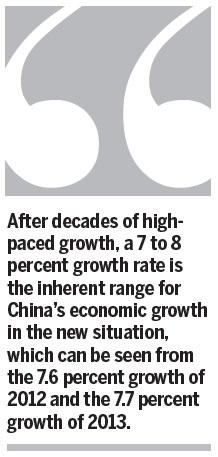
China's consumer price index grew by 2.3 percent year-on-year in the first quarter, but declined by 0.32 percent from the previous three-month period. The generally steady consumer price index contains no sign of deflation as some have claimed. Some analysts believe that a CPI below 3.5 percent will leave space for the enforcement of a loose monetary policy, and reinforce market expectations for banks' deposit reserve ratio to be lowered. But the assertion that a slowed rise in the CPI should be followed by an easier monetary policy reflects a lack of understanding about monetary policy. As an important regulatory tool, a country's monetary policy will tighten if its economy appears overheated and stays at a high level of inflation. On the contrary, a loose monetary policy should be maintained, such as through interest rate cuts, to create employment if the country's economy suffers a big downturn and its unemployment rate keeps soaring. The lack of any sign of overheating or recession in China's economy means there is no need for excessive intervention into its economic activities through monetary policy adjustments. The country should maintain a sound and steady monetary policy since its economic growth is within a steadily growing range.
The author is chief economist with Galaxy Securities.

Copyright 1995 - . All rights reserved. The content (including but not limited to text, photo, multimedia information, etc) published in this site belongs to China Daily Information Co (CDIC). Without written authorization from CDIC, such content shall not be republished or used in any form. Note: Browsers with 1024*768 or higher resolution are suggested for this site.
License for publishing multimedia online 0108263 Registration Number: 20100000002731