|
 |
|
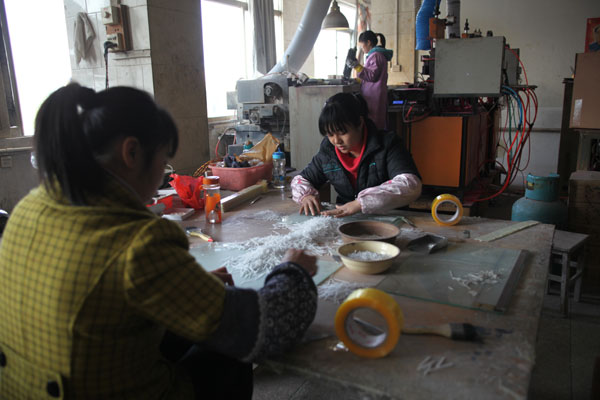
Workers cut raw materials into synthetic gemstones. In 1990, China became the world's largest cubic zirconia producer. Photo by Huo Yan / China Daily |
Producing synthetic stones no longer delivering glittering profits, reports Li Yang in Wuzhou, Guangxi
Wuzhou city is located in a valley on the border between Guangxi and Guangdong, where three rivers converge into the big Xijiang River. Wuzhou prospered as a commercial hub of five neighboring provinces connected by the busy waterway from the 18th century to mid- 20th century.
|
 |
 |
The locals, speaking their Cantonese dialect, like to think of Wuzhou as the west gate of the better-off Guangdong rather than the east gate of the poorer Guangxi, to which it actually belongs.
From tea to gemstones
The city had not appeared on China's economic map, except for the production of black tea, until 1982, when a young Hong Kong businessman named Cui Fuming moved his artificial gemstone-processing workshop there from Guangzhou, tapping into a supply of cheap labor and hydroelectricity.
Cui had no way of knowing he was helping the city to become the world's largest synthetic gemstone base within a few short years.
In 2013, Wuzhou produced 100 billion of the stones, nearly 80 percent of the world's total. More than 90 percent are exported to developed countries.
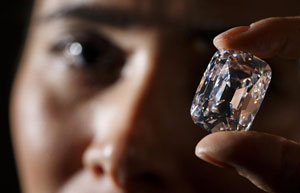
The most popular are synthetic diamonds (cubic zirconia), which are made by cutting and polishing zirconia, a rare, transparent crystal that has a higher refraction index and slightly lower hardness than real diamonds.
Former Soviet scientists created the crystal for military purposes using high-temperature crucibles in the 1970s. Their use changed to daily life later on.
In the 1980s, Cui paid his Wuzhou workers about 100 yuan ($18) a month to make zirconia crystal bars, cut them into small pieces and polish them into customized shapes.
By 1990, China had become the world's largest producer of zirconia after Chinese factories successfully replicated the bronze electronic tubes used in Japan, which increased the output per crucible 20 times over.
Were it not for the cheap hydropower available in mountainous Guangxi, however, the industry probably would not have taken root in Wuzhou.
|
 |
 |

Copyright 1995 - . All rights reserved. The content (including but not limited to text, photo, multimedia information, etc) published in this site belongs to China Daily Information Co (CDIC). Without written authorization from CDIC, such content shall not be republished or used in any form. Note: Browsers with 1024*768 or higher resolution are suggested for this site.
License for publishing multimedia online 0108263 Registration Number: 20100000002731