China's economic fundamentals are much healthier than most other emerging markets and the country is one of the least vulnerable emerging market economies to US tapering in 2014, said a Deutsche Bank report released on Wednesday.
Since the beginning of December, the Chinese H share index has dropped by 16 percent, triggering fear among some investors that China's economic situation has deteriorated in recent weeks — just like those in Argentina and Turkey.
"We think this market perception of China is wrong," said Ma Jun, chief economist for greater China with Deustche Bank. "There is no need for the Chinese government to ease macro policy to stimulate the Chinese economy."
His conclusion is based on a group of factors ranging from the stability of the yuan to a more stable political situation since the change of the Chinese leadership in 2013.
Compared with other emerging market currencies, China's RMB has been the most stable in the past weeks and will likely remain stable in 2014, Ma said. He expects the RMB to appreciate against the US dollar by about 2% in 2014, although a modest increase in its flexibility is possible.
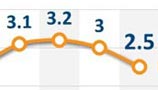
He noted that macro fundamentals are much stronger in China than in many other emerging market countries. China's GDP growth was 7.7% in the fourth quarter, higher than the 7.5% annual target, and its volatility was within 0.2-0.3 percentage points on a year-on-year basis in the past few quarters. Its CPI inflation was 2.5% in December and will likely remain around 2.5% in coming months, representing its most stable period in history.
Although many people view the drop in China's manufacturing PMI in January (by 0.5 percentage points to 50.5) as an indication of China's economic weakness and some even say the sell-offs in many emerging markets were partly triggered by the Chinese PMI number, the Deutsche Bank economist believes that is a gross exaggeration of the significance of a monthly PMI figure, especially in January.
"Historically, Chinese PMI could move by anywhere between -1.7 percentage points to 0.2 percentage points in January (from December) due to the Chinese New Year effect. In addition, at the beginning of this year, some cities implemented emergency measures to prevent a sharp rise in the air pollution index by tentatively suspending the production of some coal-burning factories," he said.
China is implementing its most aggressive structural reforms in decades, which are helping address its financial risks, Ma said.
In his view, it is unlikely that China's wealth management product defaults and loans to local government financing vehicles will lead to a blow up of the financial system.
"Given the recent resolution of the China Credit Trust event, the authorities are embarking on a path toward 'managed defaults' to gradually improve risk pricing in the trust loan sector, while tightening rules on shadow banking activities," said Ma.
He added that the local government bond market will be developed to gradually replace LGFV loans as a more important source of financing for local government capital expenditures.

Copyright 1995 - . All rights reserved. The content (including but not limited to text, photo, multimedia information, etc) published in this site belongs to China Daily Information Co (CDIC). Without written authorization from CDIC, such content shall not be republished or used in any form. Note: Browsers with 1024*768 or higher resolution are suggested for this site.
License for publishing multimedia online 0108263 Registration Number: 20100000002731