Comments
  Print
Print  Mail
Mail  Large Medium Small
BEIJING - China's budget system is coming under the microscope as the public begin to question departments striving to empty their coffers to meet budgetary targets.
National public fiscal expenditure for the past 11 months totaled about 11.5 trillion yuan ($1.88 trillion), and about 2 trillion yuan remains to be spent in December, according to data from the Ministry of Finance.
That sum might even be higher toward the end of the year. Last year spending exceeded budget by about 9 percent.
The public are concerned that the December splurge will mean corruption and waste. It is the season for exorbitant procurement and embezzlement.
"December spending always outweighs the average for the other 11 months. This tells us that the budget system is still far from perfect," said Wang Yongjun, a professor at the Central University of Finance and Economics.
The problem lies in the simplistic system of budget management, whereby a new year's budget is based on last year's spending, Wang said.
"It is an incitement to profligacy and waste," he said.
China has been trying to avoid the end of year splurge for some time and the portion of annual spending in the December binge fell from 26.8 percent in 2008 to 16.6 percent in 2012.
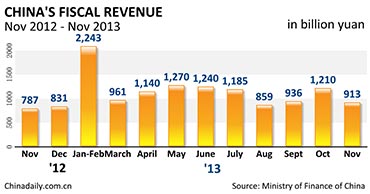
This year though, it looks like even higher spending in December compared with previous years, as fiscal revenue has grown unevenly in the past eleven months. Fiscal growth was sub-zero in the first half year, plugging capital flow, said Bai Jingming, a researcher with the Ministry of Finance.
The money left does not even have to be spent in December. It can be transferred to next year's budget, Bai added.
Budget reform will be prominent in the next year of reform: compliance and assessment will be supported by strict regulations, said Yang Zhiyong, a researcher at the Institute of Finance and Trade Economics of the Chinese Academy of Social Sciences.
A series of detailed and easily enforced rules have attempted to put an end to official extravagance and the reform agenda promises efficiency and transparency.
Wang Yongjun wants to see better budget calculation and approval, with the introduction of a balanced cross-year budgets, allowing departments to spend money left over on next year's budget items.
Only with total fiscal transparency will public doubt be alleviated, once they know how the government spends every yuan, said Bai Jingming.
Copyright 1995 - . All rights reserved. The content (including but not limited to text, photo, multimedia information, etc) published in this site belongs to China Daily Information Co (CDIC). Without written authorization from CDIC, such content shall not be republished or used in any form. Note: Browsers with 1024*768 or higher resolution are suggested for this site.
License for publishing multimedia online 0108263 Registration Number: 20100000002731