Comments
  Print
Print  Mail
Mail  Large Medium Small
|
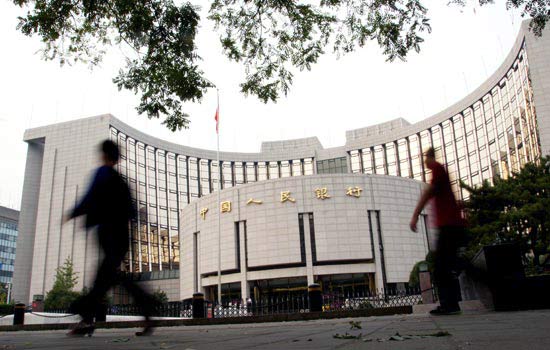 The headquarters of the People's Bank of China in Beijing. [File photo / China Daily] |
The People's Bank of China plans to introduce third-party custodians into peer-to-peer lending, after numerous cases of fraud emerged last year connected with this emerging mode of financing.
Peer-to-peer lending refers to direct lending to unrelated individuals without the involvement of any financial institution as an intermediary. P2P lending takes place online through specialized websites.
P2P companies are supposed to act only as brokers, but many in China started raising funds directly. Numerous cases of fraud involved with this activity drew the attention of regulators.
"We should set business boundaries while promoting the development of peer-to-peer lending companies," a PBOC official told an inter-ministerial meeting on Monday in Beijing held to discuss illegal fundraising. Officials didn't say when any new rules will be announced or take effect.
One way to keep brokers from taking clients' money is to involve third-party custodians, the official said.
Third-party custodian services already exist in equity brokering in China.
P2P lending volumes have tripled annually since this type of financing appeared in China in 2006, according to China Business News' new finance research center.
Outstanding loans on domestic online P2P platforms stood at 10 billion yuan ($1.6 billion) by the end of 2012. There were about 200 lending platforms at that point, with about 50,000 investors.
In China, P2P lenders aren't classified as financial institutions, and there aren't any specific rules governing the sector, so these lenders function beyond the scope of regulators.
The absence of regulations has led to risky practices by P2P lenders, such as investing with clients' funds and failing to conduct due diligence on borrowers.
The sector is so chaotic that local media reported in October that at least one P2P lending company went bankrupt every day.
"Peer-to-peer online lenders have met the market's demand for fast mini-loans, but the sector is in chaos due to the absence of regulations and entrance requirements," said Huang Qingyun, an analyst with China Market Research Reports and Consulting, an online consultancy.
According to the central bank, three types of activity by P2P lenders will be classified as illegal fund-raising, which could draw the death penalty in China under certain circumstances.
The first type of activity involves a P2P lending company packaging borrowers' applications into financial products, which are then sold to investors (essentially a form of securitization), or pooling investor money and then seeking borrowers.
In the second type, P2P lenders will be held accountable if they fail to conduct proper due diligence and let borrowers raise large amounts on their platforms for financial investment or relending.
In the third, Ponzi schemes are also strictly banned. A Ponzi scheme involves fundraisers paying returns to investors from their own money or the money paid in by subsequent or other investors, rather than from profits earned by the individual or organization running the operation.
 Honda models at 2013 Guangzhou auto show
 Honda Jade at the 2013 Guangzhou auto show
 Toyota's new Reiz debuts at 2013 Auto Guangzhou
 Jimmy Lin Zhiying, models at Toyota pavilion
 Volvo all-new S60L world premiere at Guangzhou auto show
 2013 Guangzhou auto show carmakers' eventers
 Models at Volvo pavilion at 2013 Guangzhou auto show
 Lexus new hybrid hatch CT200h world premiere in Guangzhou
Copyright 1995 - . All rights reserved. The content (including but not limited to text, photo, multimedia information, etc) published in this site belongs to China Daily Information Co (CDIC). Without written authorization from CDIC, such content shall not be republished or used in any form. Note: Browsers with 1024*768 or higher resolution are suggested for this site.
License for publishing multimedia online Registration Number: 20100000002731