Comments
  Print
Print  Mail
Mail  Large Medium Small
|
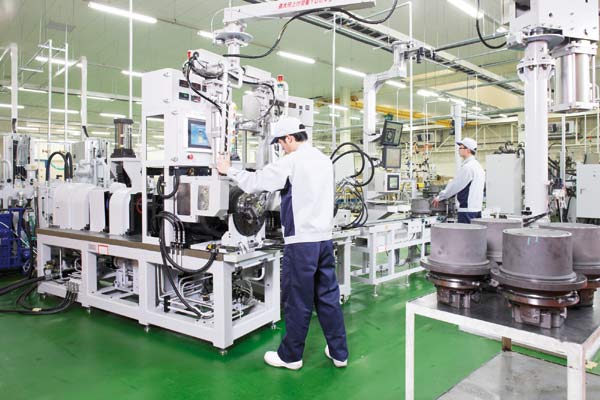 Nachi (Jiangsu) Industries Co Ltd is one of the high-tech companies that has been attracted to Zhangjiagang. Among other things, the company makes precision cutting tools, and industrial robots.[Photo / China Daily]
|
It's out with the old and in with the new industries as Zhangjiagang looks beyond steel to new ways of doing business
China's largest private steel company, Shagang Group, plans to move away from steel as its primary business in as little as three years. The seismic shift being considered by the steel stalwart, unthinkable during the boom a decade ago, is the clearest indication to date of the mounting pressure traditional manufacturing sectors in China are facing to stay viable in a rapidly changing domestic and global market.
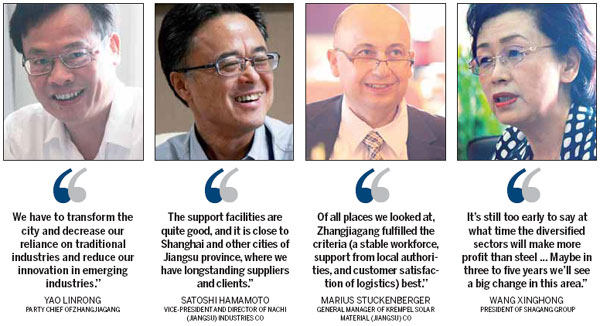
But in the city of Zhangjiagang in Jiangsu province, the base for Shagang's steel mill operations, some domestic and foreign companies see opportunity in the challenges besetting traditional industries.
They are the flag bearers of the so-called emerging industries, and they have begun to set up production facilities across the city.
Among those prepared to take a punt on what they perceive to be huge potential in the evolving Chinese market are German solar energy material manufacturer Krempel Group and Japanese machining and robot manufacturer Nachi Group, both of which set up operations in Zhangjiagang last year.
It is no coincidence that these companies chose to do business in the small but economically dynamic city on the Yangtze. Often held up as a success story of China's rapid industrialization and urbanization, Zhangjiagang has implemented a number of progressive development policies to attract investment from emerging industries.
Success, or failure, is likely to be viewed as a weathervane for other economic zones across the country.
"If we want to keep economic growth and also leave a beautiful city for generations to come, we have to transform the city and reduce our reliance on traditional industries and increase our innovation in emerging industries," says Yao Linrong, Party chief of Zhangjiagang.
"We need to develop an economy with low resources, low energy consumption, and low emissions."
While China maintains pride of place as the world's manufacturing hub, industrial transformation has been a strategic objective for the country in recent years as it seeks to mitigate expected cuts to employment and to government revenue that follow further decline in the profit margins of traditional sectors.
The old bastions of business are being encouraged to diversify, or at the very least to operate in a more fiscally sustainable fashion way. On October 15, the Government announced it would block new projects in a number of sectors suffering from overcapacity, including steel, aluminum, shipbuilding and cement.
Zhangjiagang, ranked in the top three of China's 100 county-level cities in terms of comprehensive competitiveness, needed little prompting to embark on a program of industrial reform.
Traditional businesses, such as printing and dyeing, have been moved out of the city's 120 square kilometers of prime industrial land and into less developed regions to make way for new projects.
Bigger companies in traditional industries have been encouraged to introduce new technology and diversify their brands, and companies that deal in cutting-edge technology, new energy and new materials have been courted and assisted in setting up shop.
 World's first 1-liter car debuts in Beijing
 Paper-made furniture lights up art show
 Robots kick off football match in Hefei
 Aerobatic team prepare for Aviation Convention
 China Suzhou Electronic Manufacturer Exposition kicks off
 'Squid beauty' and her profitable BBQ store
 A day in the life of a car model
 Vintage cars gather in downtown Beijing
Copyright 1995 - . All rights reserved. The content (including but not limited to text, photo, multimedia information, etc) published in this site belongs to China Daily Information Co (CDIC). Without written authorization from CDIC, such content shall not be republished or used in any form. Note: Browsers with 1024*768 or higher resolution are suggested for this site.
License for publishing multimedia online 0108263 Registration Number: 20100000002731