Succession proves a tricky art in business


|
 |
|
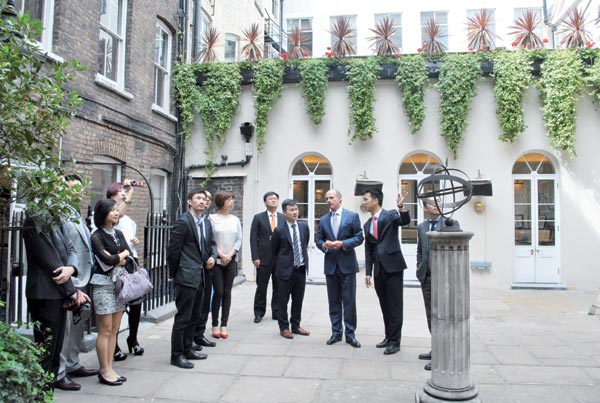
Young Chinese entrepreneurs who traveled to Britain recently on a tour conducted by Fleming Family & Partners of London.[Photo/China Daily] |
Rich second generation taught how to keep the family wealth
Whether they were born with silver chopsticks in their mouths is moot, but we can be sure that they have led very comfortable lives, received the best education and wanted for nothing materially.
These are the children of the first batch of China's private entrepreneurs who have grown immensely rich since reform and opening-up began in the late 1970s. As these business people have approached, reached and passed retiring age, their children, many born in the 1980s, have been groomed to take over the family concern.
Because private businesses did not exist in China during the planned-economy era, from 1949 when the People's Republic of China was founded to the late 1970s, private businesses that have appeared since the 1980s are new.
Most of the rich private entrepreneurs in China are pioneers of their family businesses, meaning their wealth has been in the hands of two generations at most.
As Chinese entrepreneurs prepare to pass their wealth to their offspring, questions often surface about what form the family business will continue in and the risks that it will face after the reins change hands.
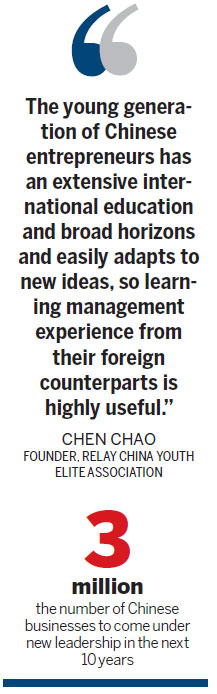
Beijing Huashang Institute of Management, a training body mainly for private enterprises, says that over the next five to 10 years, 3 million Chinese businesses will come under new leadership and that as many as 90 percent of bosses of private companies hope to pass them onto their children.
The methods of grooming successors include sending them to top-notch schools and universities and throwing them in at the management deep end and trusting that they will swim. One group of 13 young business people, all in their 20s or 30s, chose another path recently, traveling to Britain to see how its family firms run their businesses and handle the matter of succession.
"Visiting and learning from British family firms was a good way to give us more practical experience," says Ling Chao, 35, vice-president of Orient Holdings Group of Shanghai. Ling has been involved in the family business since he was 23, when he chose to work in the financial department after graduating from university in Xi'an, capital of Shaanxi province. Now the business includes investment, asset management, trade and infrastructure construction.
"Most British family firms have a long history and their own business culture, playing important roles in the British economy in stability, creating jobs and the entrepreneurial spirit," he says.