Top film regulator relaxes control on scripts


|
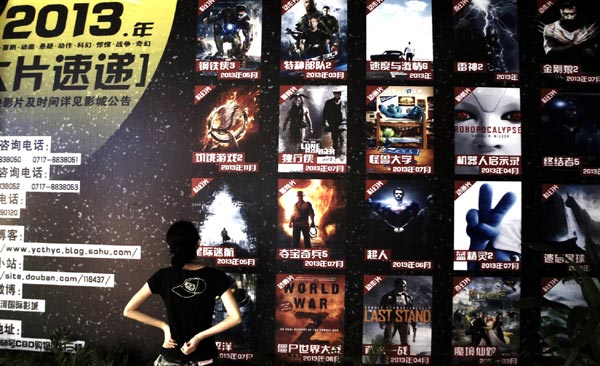 China's film governing body has begun to loosen its control on the industry, but many people are still calling for the introduction of a rating system to further develop the industry. [Photo/China Daily] |
The top regulator of China's booming film industry has relaxed its controls on script content, but it's too soon to say whether the move will bring major changes to the industry, insiders said.
The State Administration of Press, Publication, Radio, Film and TV released a policy on Wednesday, saying that films of "general subjects" no longer need to have their scripts vetted by the institution.
Filmmakers of such movies are only required to publicize a synopsis on the administration's website to get a license to shoot. If the summary does not clearly explain the film's subject, the administration will ask for more information.
Films dealing with "significant subjects" - ethnic groups, religion, military, diplomacy, police, the judicial system or historic events - still must submit full scripts to obtain a shooting license, said an employee of the administration, who spoke on condition of anonymity.
This is not the first time the administration has loosened controls on movie content.
In 2009, authorities amended the rules so that films not depicting "significant subjects" only had to submit a 1,500-word summary for examination to get a shooting license, whereas before they had to provide a full script.
The new move on Wednesday further simplifies the procedure by only requiring filmmakers to post a summary on the administration's website.
But all finished films must still be approved by the administration prior to their theatrical release.
Director Zhang Qi called for further reforms to relax controls on script content.
"For some filmmakers, their risks are actually increased due to the policy because they only know what content should not be included when the filming has finished," he said.
"They have to spend more money to revise a finished film than a script. The industry would really benefit from the introduction of a ratings system."
The administration currently does not have a rating system.
Du Qingchun, a professor at Beijing Film Academy, said filmmakers need to examine their scripts more carefully before administration officials do.
In 2012, China's film industry became the second largest in the world, trailing only the United States. Box office revenue in 2013 had reached 10.9 billion yuan ($1.5 billion) as of July 1, a 33.8 percent increase over the same period last year.