Comments
  Print
Print  Mail
Mail  Large Medium Small
|
 |
|
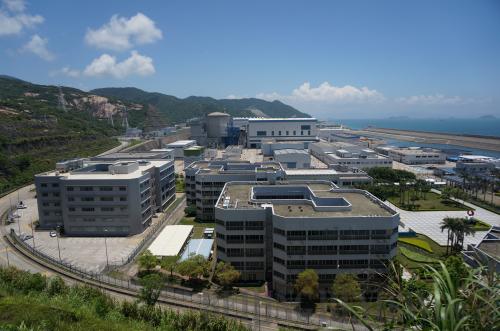
CLEAN ELECTRICITY: Pictured is Phase 1 of the Ling'ao power plant, which has two nuclear reactors that came into commercial operation respectively in 2002 and 2003.[Photo / bjreview.com.cn] |
Summer is the busy season for the Dayawan nuclear power plant, located on the scenic Daya Bay in the south China city of Shenzhen. Not only is there a peak demand for electricity, but the typhoon season also means the plant must be ready to handle any emergency.
On the night of June 30, the day before tropical storm Rumbia reached the South China sea, about 350 km southwest of Shenzhen, Dayawan's emergency response system kicked in to prevent its nuclear facilities from being damaged. Neither the plant nor its personnel were harmed.
"As long as there are potential threats, we'll utilize our emergency response system to keep our nuclear power plants safe," said Zhao Fuming, associate chief safety engineer of Dayawan Nuclear Power Operation and Management Co. The Dayawan plant has successfully fended off six typhoons since going into operation in 1994.
Japan's Fukushima nuclear accident in March 2011, which brought China's once thriving nuclear power industry to a grinding halt, has spurred a rise in the level of nuclear safety and emergency response in China.
China relaunched its nuclear power projects in October 2012, requiring that all new nuclear power plants meet the world's highest safety standard.
Drawing on the global response to nuclear accidents, especially the Fukushima accident, China's nuclear authority has also revised its national nuclear emergency plan from its 2005 edition.
The plan, approved by the State Council and released on June 30, specifies how national and provincial authorities and nuclear power operators should respond to nuclear emergencies and requires accurate information be published in a timely and transparent manner in the event of an incident or accident, according to the National Nuclear Emergency Response Office. The plan also expands emergency response to accidents that may happen during the transportation of spent nuclear fuel or aerospace vehicles equipped with nuclear devices.
"Nuclear safety is the lifeline of the nuclear power industry and the emergency response system is the last firewall to ensure safety," said Ma Xingrui, Vice Minister of Industry and Information Technology and Chairman of China Atomic Energy Authority (CAEA).
The basic tasks of nuclear emergency response are to effectively deal with possible accidents, to control, mitigate and eliminate human harm and property loss, and to protect public and environmental safety, said Ma.
Currently, China has 17 nuclear power generating units in operation, with a combined capacity of 14.76 million kilowatts (kw), nine of which are operated by China National Nuclear Corp. (CNNC) and eight by China General Nuclear Power Corp. (CGN). Another 28 nuclear generating units are under construction, with a total capacity of 28.3 million kw.f
So far, China's nuclear safety record is clean, with no incidents or accidents above level 2 of the International Nuclear and Radiological Event Scale (INES) having taken place. There are seven levels on the INES scale: three incident levels (1-3) and four accident levels (4-7). Events without safety significance are called "deviations" and are classified below level 0. The Fukushima accident has been rated level 7.
"But we should be 100-percent prepared for the one-millionth-of-1-percent possibility [of nuclear accidents]," said Xu Ping, Deputy Director of the Department of Nuclear Emergency and Safety Regulation at CAEA.
Emergency preparedness
The Chinese Government has attached great importance to nuclear safety and emergency response since the country set up its nuclear power industry in the 1950s, said Ma.
China began construction of its first nuclear power station in 1985, and a national committee to deal with nuclear emergencies was set up by the State Council in 1991. Having gone through several rounds of government structural reforms over the past two decades, the committee has evolved to the current National Nuclear Emergency Coordination Committee, consisting of 24 ministries or departments under the State Council and the army.
 Models at Ford pavilion at Chengdu Motor Show
 Brilliant future expected for Chinese cinema: interview
 Chang'an launches Eado XT at Chengdu Motor Show
 Hainan Airlines makes maiden flight to Chicago
 Highlights of 2013 Chengdu Motor Show
 New Mercedes E-Class China debut at Chengdu Motor Show
 'Jurassic Park 3D' remains atop Chinese box office
 Beauty reveals secrets of fashion consultant
Copyright 1995 - . All rights reserved. The content (including but not limited to text, photo, multimedia information, etc) published in this site belongs to China Daily Information Co (CDIC). Without written authorization from CDIC, such content shall not be republished or used in any form. Note: Browsers with 1024*768 or higher resolution are suggested for this site.
License for publishing multimedia online 0108263 Registration Number: 20100000002731