Technology raises farm productivity


For Bai Qiangguo, 53, life on the wind-blown plains of central Ningxia Hui autonomous region was like being frozen in time: the use of excessive pesticides and fertilizers to farm the reluctant land took its toll on the little fertility there is in the soil. The land became sandier and sandier, increasingly prone to dust storms.
But science is bringing the cycle to an end and giving farmers a harvest for the future.
 |
|
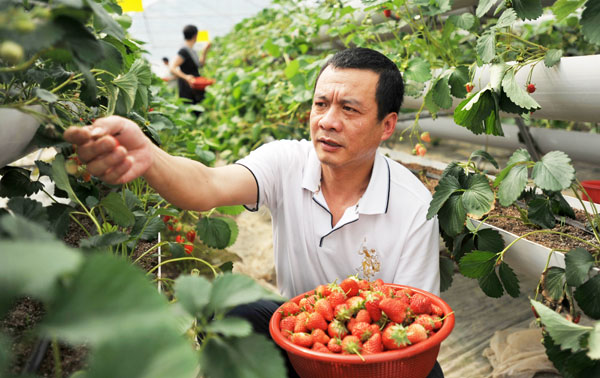
Hydroponically cultivated strawberries are harvested in Shangjie, a village in Lingchuan county, the Guangxi Zhuang autonomous region, in April. Scientific and technological authorities in Guangxi used a special 1.5 million yuan ($245,000) fund to support hydroculture in the village after a water shortage. Photo by Lu Boan / Xinhua |
"Now I work on the land during the day, and use the Internet to sell my wolfberries in the evening," Bai Qiangguo said. "I never thought I would have anything to do with high technology."
Bai and the other farmers who benefited from wolfberry planting technology in Ningxia are only a part of a much more ambitious plan of the government to boost agriculture through technology.
"If we bring technology into agriculture in the Ningxia Hui autonomous region, one of the country's poorest rural regions, we can do it in any region in China," Zhang Laiwu, vice-minister of science and technology, told China Daily.
This does not mean just adding new technology into crop planting, or to replacing labor with machines.
Instead, it is a more complex systematic reform: farmers working in commercialized farms, using high-tech equipment to improve both production and quality of the crop. On top of this, the entire community will benefit through the processing industry, logistics, and financial services system. The result will be that skilled talent will be attracted to agriculture.
"The essential factors in traditional agriculture include land, natural resources, like water and labor. But now we will integrate new productive factors like technology, modern management theory and social services," he said.
Although the methods of industrial agriculture, such as techniques for achieving economies of scale in production, are common in developed economies and increasingly prevalent worldwide, China's agriculture remained "old-fashioned", Zhang said.
According to the National Bureau of Statistics, the per capita disposable income of urban residents was 21,810 yuan ($3,520) in 2011, three times the rural per capita income of 6,977 yuan in the same year.
"The gap is much larger than the global average," Zhang said.