Comments
  Print
Print  Mail
Mail  Large Medium Small
|
 |
Report highlights strengths and weaknesses of traditional sectors
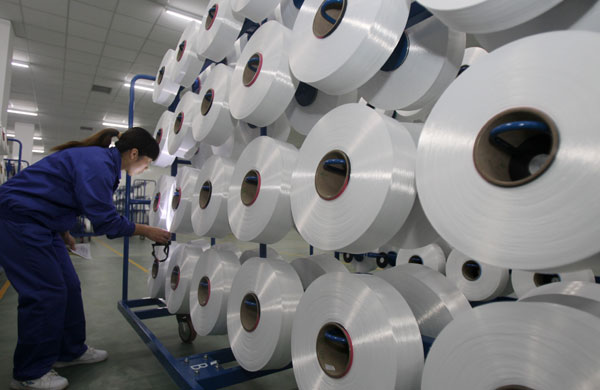
The competitiveness of China's traditional industries is weakening, while its growing competitiveness in new and emerging sectors still lacks sufficient capacity, according to a report published by the Chinese Academy of Social Sciences.
Commenting on the findings, Jin Bei, director of the Institute of Industrial Economics at the CASS, which produced the report, said China's competitiveness in some low- and high-end industries remains strong, but is much less competitive in some medium-end industries, providing an unusual U-shaped curve in industrial performance.
But Jin said: "Though China performs well in some high-tech industries, that competitiveness is mainly attributed to favorable government policies."
"The core technologies are still not ours," Jin said. "China's industrialization is far from reaching the middle and late stages."
The annual report said agricultural products and high-energy consuming, high-pollution and resource-intensive industries are where the country's traditional strength has been for many years, but this is gradually weakening.
It added that the government's industrial policies do not support some of those industries any more, and that the nation's rising labor and resource costs mean it is now losing out to some countries with lower factory prices.
But while losing some advantages in traditional industries, China is gaining in other areas, most notably in electronics, machinery and chemical products, according to the report.
For the first time, the report measured the technological sophistication of China's various export markets.
It found that China's export sophistication level is now in the world's top 40 - above the world average, but still lagging well behind the United States, Germany and Japan.
Zhang Qizi, the researcher at the Institute of Industrial Economics who oversaw the writing of the report, noted that although China remains competitive in some of its traditional industries such as textiles, it still needs to strengthen such competitiveness..
"For example, China is strong in motorcycles. But if you dig deeper, you will find it holds an advantage only in low-powered motorcycles, not high-powered ones," Zhang said.
"China has also found a new strength in shipbuilding, but is still weak in building the engines that drive the ships."
To improve China's industrial competitiveness, the report suggests market forces should play a greater role.
"To adjust China's industrial structure, administrative forces and macroeconomic policies should play a limited role," said Jin.
"The traditional ways of enhancing industrial capacity, such as setting up industrial parks and giving cheap land and capital to enterprises, have produced many economic side effects, such as overcapacity," Jin said.
He said the country should rely more on building a fair, competitive environment, in which good companies could be allowed to thrive while bad companies could be allowed to fail.
 HK's new cruise terminal receives luxury liner
 Future points to carbon trading
 Seafood businesses flounder amid spending cut
 Equities slump amid slow-growth estimates
 Auto show opens with much fanfare in Xi'an
 Sunnylands summit fuels Chinese tourism interest
 'Palace on wheels' on sale for $3.13m in Dubai
 Fortune smiles on Chengdu as forum concludes
Copyright 1995 - . All rights reserved. The content (including but not limited to text, photo, multimedia information, etc) published in this site belongs to China Daily Information Co (CDIC). Without written authorization from CDIC, such content shall not be republished or used in any form. Note: Browsers with 1024*768 or higher resolution are suggested for this site.
License for publishing multimedia online 0108263 Registration Number: 20100000002731