The choice is sustainable development


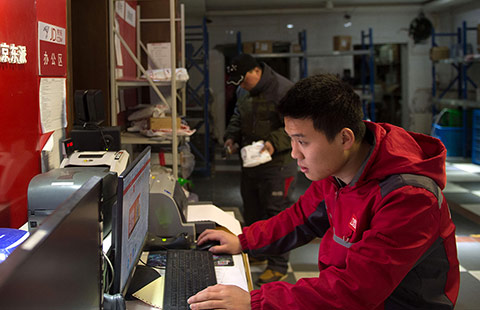
Also on the minds of many is a dwindling demographic dividend. "Two factors put China's demographic dividend on the decline," said Liang. For one thing, GDP growth means higher living standards and higher wages. For another, as the generation born in the 1980s moves into the labor force, the family planning policy established in the 1970s has led to a labor shortage.
According to statistics from the World Bank, the demographic dividend - a period of high economic growth due to a large labor force and low fertility rate - once contributed to 30 percent of China's economic growth for many years. But now, the figure is falling. Ma Jiantang, Commissioner of the National Bureau of Statistics, predicted that China's working-age population would experience a steady reduction.
Cao Heping, Associate Dean of School of Economics of Peking University, told reporters at the first sessions of the 12th National People's Congress and 12th National Committee of the CPPCC that the rising cost of labor makes it difficult to continue exploiting the once-competitive advantage of low labor costs. In the short run, the disappearance of the demographic dividend would significantly pull down corporate profits. In the long run, it is conducive for China to realize sustainable development and quicken the transformation of enterprises. Therefore, at the current stage, China should try to gain dividend from reforms rather than its population by improving labor efficiency and undergoing reforms in its currency and capital markets.
In addition to the absence of the demographic dividend and cost advantage, China for a long time has stuck to an unsustainable growth model - high energy consumption, high emissions and heavy pollution. Su Guocui, a member of the CPPCC National Committee and deputy chief engineer of China Waterborne Transport Research Institute under the Ministry of Transport, argued that when experiencing rapid growth, the environment paid a terrible price. Such a development pattern is not sustainable, and a transformation is urgently needed.
A green book recently published by the Chinese Academy of Social Sciences states that since China is now undergoing accelerating industrialization and urbanization, it has taken a lead in energy consumption like oil and coal. In the near future, the country will undoubtedly face surges in energy demand and a widening energy gap. Huge resource and energy consumption will surely result in the high emissions of greenhouse gases. Obviously, the traditional economic growth model is no longer compatible with the goal of sustainable development. For this reason, China is bound to go through a low-carbon transformation.
Ongoing changes
Since the Chinese government established a strategy of economic restructuring, China, when maintaining stable and rapid development, has also made some progress in growth quality.
The proportion of service industries against GDP rose steadily from 42.6 percent in 2009 to 44.6 percent in 2012.
Domestic demand has become the major driving force for economic growth. In 2012, consumption contributed 51.8 percent to the total economic growth, 1.4 percentage points higher than investment. "The engine for China's economic growth should shift from investment to consumption," said Liu Chuanzhi, chairman of Legend Holdings Ltd., who called for tax reductions to stimulate consumption. "China's GDP as well as fiscal revenue have maintained rapid growth for years. If the increased revenue goes to people's pockets, domestic consumption will be significantly boosted."
In some sectors, overcapacity has been effectively solved, and GDP growth has been less and less dependent on energy consumption. Moreover, in 2011, China outstripped the United States in the number of patent applications received by the State Intellectual Property Office, accounting for one quarter of the world total. In 2012, 54.5 percent of agricultural growth came from technological progress, up from the 53.5 percent in 2011.
Don't miss

- China takes center stage in preparedness for low-carbon economy
- China's growth powers world economy
- The path economic reform should take
- Chinese president says BRICS cooperation benefits world economy
- Improving growth quality right direction for China, says expert
- China's economy may see strong rebound