Comments
  Print
Print  Mail
Mail  Large Medium Small
A dramatic change is taking place in China's liquidity supply situation as capital flows out of the world's second-largest economy amid calls for monetary authorities to look for new ways to inject money into the economy, said analysts.
|
 |
|
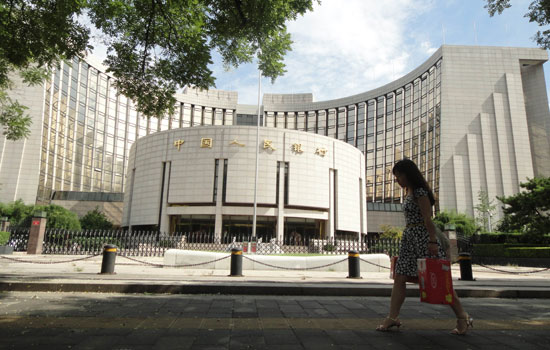
The People's Bank of China headquarters in Beijing. Experts say the central bank needs to find new ways to issue currency if it wants to maintain a stable increase in the money supply. [Photo/China Daily] |
"For a long time, Chinese banks' yuan holdings for purchasing foreign exchange have been a channel for the central bank to create money. Now the old pattern is about to change, which means the central bank needs to find new ways to issue currency if it wants to maintain stable money supply growth," said Cao Yuanzheng, chief economist at the Bank of China Ltd.
China posted a monthly capital outflow in August for the third time in 2012, as its economic growth fell to a three-year low and softened for the sixth consecutive quarter.
Yuan holdings among banks for purchasing foreign exchange, an important measure of capital flows, declined by 17.4 billion yuan ($2.75 billion) in August to 25.64 trillion yuan, marking the second straight monthly fall.
It widened from a decline of 3.8 billion yuan in July as the nation's economic growth slowed to its lowest rate in three years.
Foreign exchange has become a main source of the country's liquidity over the past two decades as the central bank sterilized its fluctuation to stabilize the yuan exchange rate.
Yuan holdings of foreign exchange purchases started to increase at the beginning of the year after three consecutive monthly declines in the fourth quarter of 2011. But the hikes ended in April, when a 60.6 billion yuan monthly fall was reported.
In the first eight months, the average monthly increase of yuan holdings was only 35.2 billion yuan, far from the average monthly gain of 231.6 billion throughout last year.
"In August, despite the significant drop in international market hedging demand, banks' yuan holdings still declined. This proves that pressure for yuan devaluation will remain in the medium and long term," said Liu Yuhui, director of the financial lab of the Chinese Academy of Social Sciences.
This year, offshore non-deliverable yuan forwards have been higher than the onshore spot exchange rate, and the spread between the two is likely to become much greater, "which indicates that expectations remain that the yuan will depreciate", said Cao.
"But we tend to believe that the conditions do not exist for the yuan to depreciate further, as the Chinese economy is still in a stable and controllable range, and foreign reserves remain large."
The depreciation tendency once again indicates that the yuan's exchange rate is close to equilibrium, he said.
"We believe that capital flows related to yuan exchange rate expectations is the most uncertain factor affecting overall capital flows," said Wang Tao, head of China economic research at UBS Securities Co Ltd.
Capital outflows will be constant and substantial as China's current account surplus continues to decline and global demand remains weak. The trend is also due to growing expectations that the yuan will depreciate, and the fact that Chinese residents prefer to hold foreign assets, she said.
"The financial account deficit plus a lower current account surplus means that China may have entered a new era, that is, the stagnant growth of foreign exchange reserves."
 High–tech gadgets, not girls, main attraction at Beijing auto show
 Infographic: Highlights of China Q1 economic data
 Top 10 luxury cars at Beijing auto show
 Highlights of smart hardware on display at 2016 GMIC Beijing
 Two students return from abroad to open beer factory
 Man aims to provide freshest ice cream possible
 Top 6 domestic new-energy vehicles at Beijing auto show
 Hanover Fair opens with Sino-German alliance launch

Copyright 1995 - . All rights reserved. The content (including but not limited to text, photo, multimedia information, etc) published in this site belongs to China Daily Information Co (CDIC). Without written authorization from CDIC, such content shall not be republished or used in any form. Note: Browsers with 1024*768 or higher resolution are suggested for this site.
License for publishing multimedia online 0108263 Registration Number: 20100000002731