|
 |
|
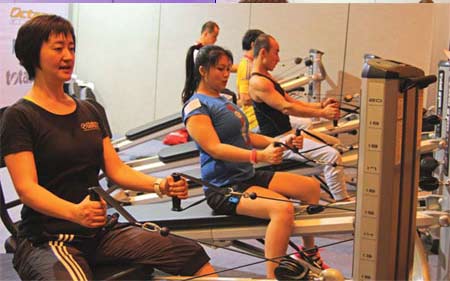
Visitors work out at the China Fitness Summit in Beijing. Some 2,000 instructors and fans participated in the event. Provided to China Daily |
Twenty years after modern fitness centers appeared in China, the market is still in its infancy and going through a reshuffle.
"China's young fitness industry has already felt the growing pains," says Yan Sihai, founder and general manager of ChinaFit, a web portal for the fitness industry.
Going to gyms and fitness classes in China is not yet a widely accepted lifestyle, more an "impulse consumption behavior", says Zhang Qing, founder of KEY-solution, one of the oldest sports consulting companies in China.
Zhang says fitness is largely seen as an individual activity involving body and exercise equipment.
"It's hard to endure for Chinese people who love social life so much and overlook individualism," he says.
"The competitors to fitness centers in China are actually cinemas, KTVs (karaoke clubs), shopping malls and bars. We are asking people to give up their spare time and do something," says Macdonald.
In an attempt to compete against rivals within and outside the sector, fitness centers are cutting prices for memberships, training classes and other services.
"Simply lowering the price without improving the service is never a solution, especially when labor and rent costs are soaring and the margin is as thin as the blade," says Zhang, who believes that the core competitiveness should lie in good service.
Another fly in the ointment is consumers' distrust in clubs. Many clients fear clubs they have joined - one year is the usual membership term in China - may close suddenly and they will not receive a refund.
On the other side, investors and operators worry about retention rates.
"The average retention rate for Chinese fitness clubs is around 20 percent, which means 80 percent of time they have to find new clients to fill in the blanks," says Liu Xu, founder of Possibility Consults, a wellness consulting company based in Beijing.
Hosa Fitness Clubs, one of the biggest fitness chains in China, has more than 500,000 members. Currently its retention rate is about 50 percent.
Wu Chenghan, director of operations at Hosa, says his aim is to increase that to 70 percent within two years. He also announced a rash of new gyms, from the current 82 to 300 by the end of 2013.
Wu says Hosa is changing annual memberships fees to monthly ones to better suit customers' schedules. A pilot scheme is up and running in Xiamen, in southeast China's Fujian province, in cooperation with the local branch of Bank of China, one of the largest banks in China.
"Many people in Xiamen are doing business and travel a lot," says Wu. "They love monthly membership because they don't have to pay when they are away on business for some time."
He says Hosa hopes to roll out the new payment program in all its gyms within a year.
"It also helps to build the trust of your members because they feel the banks' support is more reliable," Wu adds.


Copyright 1995 - . All rights reserved. The content (including but not limited to text, photo, multimedia information, etc) published in this site belongs to China Daily Information Co (CDIC). Without written authorization from CDIC, such content shall not be republished or used in any form. Note: Browsers with 1024*768 or higher resolution are suggested for this site.
License for publishing multimedia online 0108263 Registration Number: 130349