Electric vehicle industry in the slow lane
Updated: 2012-10-26 15:45
By Wang Chao (China Daily)
|
|||||||||||


Report ranks Chinese market fifth in world for maturity and highlights barriers to growth
A recent Mckinsey & Company report on the maturity of the Chinese electric vehicle market has spurred discussion on Chinese EV performance and industry prospects.
The Mckinsey report ranks the maturity of the Chinese EV market fifth in the world after Japan, the United States, France and Germany.
|
 |
|
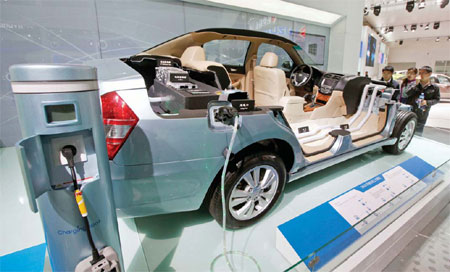
The second-generation electric vehicles of BYD on display at a recent car exhibition in Beijing. A Mckinsey report ranks the maturity of the Chinese EV market fifth in the world after Japan, the United States, France and Germany. Da Wei / for China Daily |
While not everyone agrees with the report, it does reflect issues in the Chinese market.
Six indexes were used to evaluate the market's maturity level, including supply, market share, and research and development capabilities.
According to the report, 7,931 electric vehicles were delivered by US companies during the second quarter, up 28 percent on the first quarter, and 4,240 by Japan, but only 235 were delivered by Chinese companies, a drop of 31 percent on the first quarter's 343.
Yin Chengliang, deputy director of the National Engineering Lab, disagrees with the McKinsey ranking, citing EV maker alliances with local governments to deliver large scale pilot operations in parts of the country.
 |
But Yin admits there are few purchases from individuals in China, unlike in Europe and the US, due to high prices, safety concerns and lack of infrastructure.
Since the first two mass produced electric vehicles, the Nissan Leaf and Chevy Volt, rolled off production lines in 2010, most purchases in the US and Europe have been by individuals, while in China the major buyers are local governments and State-owned companies.
High prices also drive away potential customers, according to Yin. The Chevy Volt is priced at around $40,000 in the US but after subsidies the actual cost is slightly above $20,000. In China, the same model costs 500,000 yuan ($80,000).
"EV prices in China don't match the average income of Chinese customers," Yin says. "People just cannot afford them."
Even domestic automakers that are adept in controlling costs cannot bring the price down, according to Yin. "This is because the core technologies in EV, the battery and the motor, are mostly imported from Western manufacturers," he says.
One factor is constant across all of the top five EV markets - in none, have electric vehicles captured a significant share of the auto market.
According to the Mckinsey report, electric vehicle sales make up a fraction of total auto sales: In Japan, 25,884 electric vehicles were delivered between January 2009 and June 2012, about 0.16 percent of total sales; and in the US, the number was 0.09 percent. In China the figure is less than 0.01 percent.
The report predicts that the situation will not improve significantly within the next five years and even in 2017, when auto production volume reaches 300,000, it is likely that EV sales will constitute just 1 percent of vehicle sales.