Commercial banks' ratio of bad loans increased in the third quarter for the first time this year, while the provision coverage ratio for the sour loans declined, according to a newspaper run by the central bank.
|
 |
|
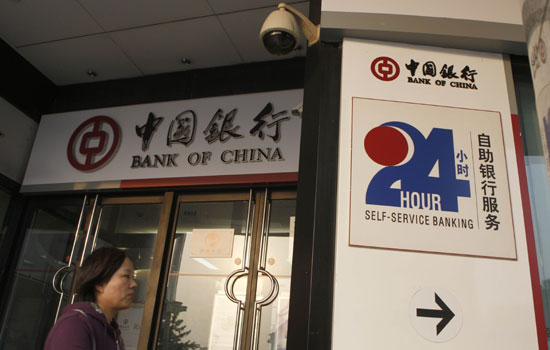
A Bank of China Ltd branch at Wangfujing Street in Beijing. The ratio of non-performing loans among lenders stood at around 0.97 percent by the end of September, up from 0.9 percent at the end of the second quarter. [Photo/China Daily]? |
The ratio of non-performing loans, or NPLs, among lenders stood at around 0.97 percent by the end of September, up from 0.9 percent at the end of the second quarter, Financial News reported over the weekend, citing figures from the China Banking Regulatory Commission.
The provision that banks set aside as a buffer reached 290.1 percent of the NPLs at the end of the third quarter, 11 percentage points higher than at the beginning of the year, but 0.1 percentage point lower than three months earlier, according to the report.
NPLs reached 456.4 billion yuan ($72 billion) by the end of June, 0.9 percent of the total outstanding loans, according to a report released by the commission in August.
The amount of bad loans had been climbing for three consecutive quarters by the end of June. The 0.9 percent NPL ratio was the same as that at the end of the first quarter.
However, Liu Yuhui, director of the financial lab of the Chinese Academy of Social Sciences, said the official figures do not sufficiently reveal the huge asset quality pressure banks are experiencing as lenders still have considerable flexibility when classifying loans as bad loans.
He said the lower provision coverage ratio was mainly because banks would like to calculate more provision as capital to meet the tougher capital requirements that will be effective from the beginning of 2013.
"No matter how high the provision coverage ratio could be, it's very doubtful whether the lenders have covered the risks sufficiently. What is certain is that banks now have very big and still increasing pressure, and have to deal with defaults by extending repayment deadlines."
Concerns over the asset quality of Chinese lenders have intensified as the government seeks financial support for new rounds of investment projects intended to spur economic growth.
Chinese banks' overdue loans, an indicator of future non-performing loans, are increasing at a faster pace.
By the end of June, the top 10 lenders' outstanding overdue loans reached 489 billion yuan, up 112.9 billion yuan from the start of this year.
Analysts had forecast that the third quarter results would show a "double-jump" in both NPLs and the ratio, similar to the fourth quarter of 2011.
The banking regulatory commission has yet to publish its official report on banking operations in the third quarter, but this is likely to come out later this week.
Although the NPL ratio of Chinese banks seems low, the potential risks are worse than the official data suggest, Xiao Gang, chairman of Bank of China Ltd, said in a commentary published in China Daily earlier this month.
"Many industries have excessive capacity after years of aggressive expansion, and a lot of money has become involved in property speculation. Eventually, indebted companies may fall into default or hit severe cash flow problems."
CBRC Chairman Shang Fulin in September urged joint stock banks to watch their bottom lines and remain aware of risks while supporting manufacturers and service providers.
By the end of September, outstanding loans to small businesses, which bear higher risks, reached 14.2 trillion yuan, up by 18.2 percent year-on-year, 1.8 percentage points higher than the average loan increase, according to Financial News.
While uncertainties over asset quality loom large, lenders' profitability will be further confined by the government's attempts to liberalize interest rates and slow fee income growth, indicating that writing off these bad loans will be more difficult.
Major banks would probably register net income growth of 11 percent in the third quarter, down from 13 percent in the second quarter, said May Yan, director and banking analyst of Barclays Capital Asia Ltd.
wangxiaotian@chinadaily.com.cn


Copyright 1995 - . All rights reserved. The content (including but not limited to text, photo, multimedia information, etc) published in this site belongs to China Daily Information Co (CDIC). Without written authorization from CDIC, such content shall not be republished or used in any form. Note: Browsers with 1024*768 or higher resolution are suggested for this site.
License for publishing multimedia online 0108263 Registration Number: 130349