Long-term potential for property sector in China still great, despite short-term blips
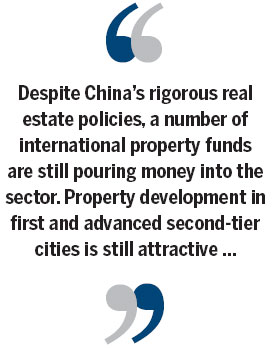
Recent reports that two foreign real estate firms, Treasury Holdings Group and Tishman Speyer, are selling their property and their respective stakes in Chinese joint ventures have triggered doubts on the real estate industry's prospects in China. Opinion remains divided on the issue, with some experts indicating that it points to a large-scale flight of foreign capital, while others term it as a special instance.
 |
To understand the real picture in the real estate industry, it is important to find the answers to three important questions concerning the sector. The real issue is to fathom whether the real estate market will be prosperous or profitless in the long run. At the same time, it is also important to gauge the real reasons behind the exit of the two foreign realty firms.
It is also important to understand if there are any foreign realty companies that are expanding and how they are coping with the business.
Since April 2010, China has come out with a series of policies to control soaring property prices and to stabilize the market. The result has been a hard landing and sluggish market conditions that have extended well into the first quarter of this year.
But according to data published by China Real Estate Information Corporation, a research agency based in Shanghai, the average housing price in most of the major Chinese cities has risen since May this year. Not only have housing prices gone up, but the property sales volume and total investment have also rebounded.
The real estate recovery has been more visible in big cities. In August, first-hand housing sales volume in Beijing reached 1.5 million square meters, a new record. Shanghai also showed excellent price pickup with property sales rising from 0.2 million sq m in January to 1 million sq m in June.
Though monthly sales and price data indicate a short-term rebound, the long-term development potential is what should be enticing for foreign realty companies.
China is still in its mid-urbanization period. The rapid growth of the middle class has necessitated the need for new and large supplies of upgraded housing.
Such demand has, however, been suppressed by the curbs on the number of houses that an individual can own and also by the higher down-payment requirements. Besides this, there is also a severe shortage of commercial real estate in many cities and important areas.
Judging from the above, it is difficult to put a picture on why foreign realty companies would want to exit the sector in China.
Statistics show that foreign capital has been exiting the real estate sector since the second half of last year, after prices stopped rising. Most foreign investors had reaped rich dividends when they exited the sector last year, considering that many of them had entered China in 2004 or 2007, when prices were only one-third or half of the current level. The absence of price increases is one of the important reasons why foreign capital is moving out of the realty sector.
The foreign capital erosion was even more evident in the first half of this year. Statistics show that foreign investment in China's property sector from January to July this year was 22.8 billion yuan ($3.6 billion; 2.8 billion euros), down 54.3 percent over the same period last year.
The yuan has also stopped appreciating and has instead depreciated against the US dollar by 0.7 percent. This is another possible reason why foreign capital is seeking safer havens.


Copyright 1995 - . All rights reserved. The content (including but not limited to text, photo, multimedia information, etc) published in this site belongs to China Daily Information Co (CDIC). Without written authorization from CDIC, such content shall not be republished or used in any form. Note: Browsers with 1024*768 or higher resolution are suggested for this site.
License for publishing multimedia online 0108263 Registration Number: 130349