The global use of the yuan as a trade settlement currency is rising, and offshore payments are increasingly taking place outside Hong Kong, according to a report released on Tuesday by Standard Chartered Plc.
However, offshore yuan-denominated bonds, or "Dim Sum" bonds, underperformed their counterparts across the rest of Asia and other developing countries, the report added.
|
 |
|
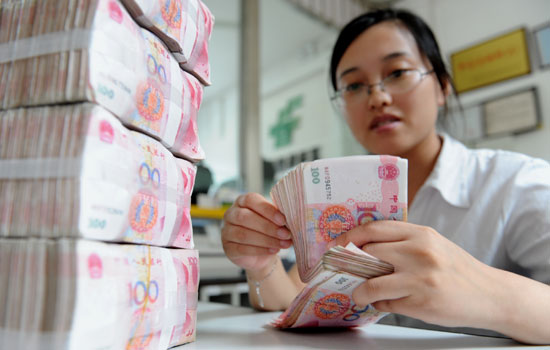
A bank employee counts money at a branch in Lianyungang, Jiangsu province. [Photo/China Daily]? |
Details show that from July to August, 12.3 percent of China's trade was settled in yuan, up from 10.7 percent in the first half of the year.
The report noted the rise came even amid "weak global demand and slowing global trade, and without any of the initial arbitrage opportunities that may have pushed corporates to switch to yuan invoicing in the early months of the experiment".
The report concluded that Asian and European firms are increasingly open to using yuan payments, most frequently from Singapore and London.
"We see many European and Asian clients shifting away from settlement in US dollars," said Eddie Cheung, foreign exchange analyst at Standard Chartered in Hong Kong.
Since the first quarter of 2012, Europe has now overtaken Asia-Pacific (except Hong Kong and the Chinese mainland) in the value of yuan settlements.
According to SWIFT, the international payment platform, the number of countries processing yuan payments increased to 91 in June from 65 a year earlier, while institutions processing such payments increased to 983 from 617.
Hong Kong accounted for around 80 percent of payments in the first eight months of 2012.
Yuan settlement across the Taiwan Straits has increased significantly since late 2011, and the imminent appointment of a settlement bank in Taipei will promote it, according to the report.
Taiwan's yuan payment value in August ranked seventh globally, up from 57th in July 2011. The payments now make up 24 percent of Taiwan's total payment value with the mainland and Hong Kong, up from 9 percent in January. The payments increased more than 35 percent in August from July.
The US now ranks fourth in total yuan payments, driven by its strong trade with China, said Standard Chartered.
But still just 0.3 percent of total US payments with Hong Kong and the Chinese mainland were made in yuan, compared with 30 percent of Singapore's.
The low levels were also similar for payments made from other developed countries such as Germany, Japan and Australia.
"We expect the yuan to continue to be adopted much more readily by companies based in emerging markets, especially Asia, followed by those in Europe," added Kelvin Lau, an economist at Standard Chartered.
Wang Yongli, vice-president of Bank of China Ltd, China's fourth-largest commercial lender by market capitalization, said the key to floating the yuan globally lies in whether the central bank will allow a larger scale of the currency's backflow.
Wang said that use of the yuan worldwide has been obviously increasing, but that insufficient backflow has hampered its prospects as an international currency.
"The government should put the majority of yuan clearance on the mainland instead of offshore markets," he said.
He added that an efficient clearance system is essential for the internationalization process of the currency, and that the government should encourage inter-bank bookkeeping clearance instead of cash clearance to further promote the global use of the currency.
But while trade settlement in the yuan appears to be increasing, overall yields of the Dim Sum bond market tightened marginally in the third quarter. The yield tightening was less than for Asian dollar credit indices such as the JP Morgan Asia Credit Index.
The adverse demand-supply situation has caused the Dim Sum market to underperform the Asian dollar bond markets, said Standard Chartered, and the lack of strong yuan appreciation means the situation is likely to continue for a while.
"The stagnation in yuan deposit growth in Hong Kong has clearly weakened demand for Dim Sum bonds, even while issuance has soared," it said.
wangxiaotian@chinadaily.com.cn


Copyright 1995 - . All rights reserved. The content (including but not limited to text, photo, multimedia information, etc) published in this site belongs to China Daily Information Co (CDIC). Without written authorization from CDIC, such content shall not be republished or used in any form. Note: Browsers with 1024*768 or higher resolution are suggested for this site.
License for publishing multimedia online 0108263 Registration Number: 130349