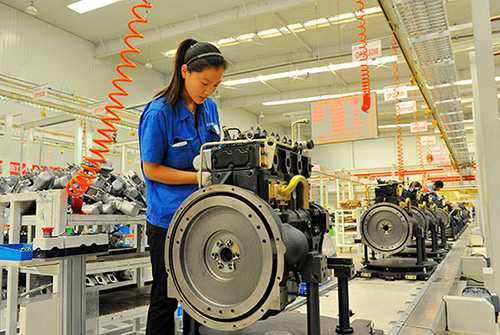
If finance is the blood stream of China's economy, manufacturing is its muscle. But for China to continue to grow, it must transform its manufacturing, with technology and know-how.
For example, before 2005, all marine crankshafts for shipbuilding in China were imported. Then China established Shanghai Marine Crankshaft Company so the country could build ships entirely by itself. Although declining world markets cause losses, the State provides subsidies. What's more, China's political leaders come to give personal support.
Other business models are taking root in China, where State ownership and domestic manufacturing are not primary. Sany is China's largest heavy machinery manufacturer and is built on the twin pillars of private ownership and global expansion. Sany misses no opportunity to enlarge its global footprint. When the copper-gold mine in Chile collapsed in 2010, Sany sent a crawler crane to help with the rescue. When the massive earthquake hit Japan in 2011 and the nuclear reactors leaked, Sany sent a huge concrete pump truck to help cool them down. In 2012, Sany bought a German company and shook up the industry.
When going abroad, though, smooth sailing is not the norm and several Chinese acquisitions have lost money. But the pace continues. In 2010, Geely Automobile purchased Volvo.
Economic growth has a downside - pollution. Environmental damage is the scourge of China, and how to balance economic growth and environmental protection is a major challenge.
The Institute of Public Environment collects environmental data from across China, compiling a database with about 100,000 pollution statistics. With others, IPE launched "Green Choice" to encourage - or coerce - multinational companies to make their supply chain greener by monitoring their suppliers' pollution. Included are GM, Nike, Walmart and Coca-Cola.
There are cases where activists have forced polluting factories to move. After the government announced plans for a massive $9 billion petrochemical plant in the wetlands of Nansha in Guangzhou, some began to protest. Few took them seriously and it seemed a wildly uneven battle. On one side was the Chinese government, central and provincial; Sinopec, China's largest oil company; and Kuwait Petroleum, one of the world's largest oil companies. On the other side, a few professors, students, citizen activists. And because economic development is vital, even negative environmental impact would likely be ignored.
But not this time. After a protracted battle, the project departed Nansha. It was a shocking win for environmentalists.
China's new leaders know they face the challenge of continuing to improve the lives of the Chinese people. The Chinese people know it too.
Dr Robert Lawrence Kuhn is an international corporate strategist and investment banker. He is the author of The Man Who Changed China: The Life and Legacy of Jiang Zemin and How China's Leaders Think (featuring China's new leaders). He is a regular commentator on China (BBC, Bloomberg, CCTV, CNBC and Euronews). The views expressed in the article do not necessarily reflect those of China Daily.

Copyright 1995 - . All rights reserved. The content (including but not limited to text, photo, multimedia information, etc) published in this site belongs to China Daily Information Co (CDIC). Without written authorization from CDIC, such content shall not be republished or used in any form. Note: Browsers with 1024*768 or higher resolution are suggested for this site.
License for publishing multimedia online 0108263 Registration Number: 130349