China, the world's largest cotton consumer, is expected to see drops in cotton consumption this year as a result of its economic slowdown and grim export business from many key Western markets.
The country currently accounts for 40 percent of global cotton consumption, and any dent in its demand is likely to put considerable downward pressure on the global cotton price, analysts said.
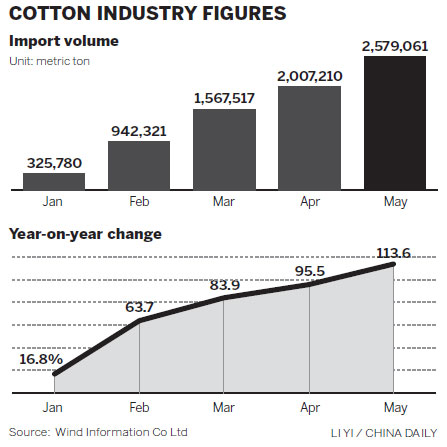
The latest data show that the export value of China's textile industry was $137.4 billion from January to July this year, a decline of 0.2 percent on the same period last year - the first decline in a decade.
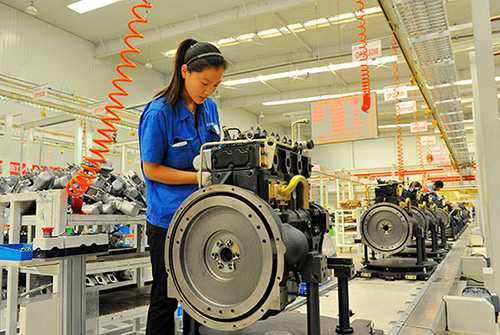
A survey by the China Cotton Association in July covering more than 100 textile companies found that 30 percent of the country's largest cotton mills had imposed limits on production, and more than half of the small mills had suspended production altogether.
The situation was blamed on high domestic cotton prices and uncertainties in both domestic and international markets, the association said.
Zhang Hongxia, chairman of Weiqiao Textile Co, China's largest cotton-textile maker, said in a recent interview with Bloomberg that the economic slowdown in China will curtail its cotton consumption by as much as 11 percent, to 8 million metric tons this year, compared with 9 million tons in 2011.
"The Chinese economy is only at the beginning of a harsh winter," she said.
Opinion is still divided among analysts about how much worse things could get, and many have viewed Zhang's estimation as too drastic.
Ma Wenfeng, a senior analyst at Beijing Orient Agribusiness Consultant Ltd, one of the industry's largest specialist consultancies, said it expects the sector to recover "moderately" during the latter half of this year, and this will somehow offset the blip.
But Ma said he believes it will take some time for the textile industry to fully regain its previous momentum, partly because the eurozone crisis is likely to continue deepening, affecting short-term overseas demand.
He added that the industry will also need time to digest its current overcapacity in supply, which is traceable to the government's 4 trillion yuan ($586 billion at the exchange rate then) stimulus package during the 2008 world financial recession.
"It is industrial overcapacity that caused the current slowdown in China," he added.
In the meantime, worrying signs for the cotton industry are beginning to show across the country.
At the port of Qingdao in Shandong province, for instance, more than 30 warehouses are reported to be piled high with mountains of cotton stock, estimated at more than 500,000 tons, according to local media.
Some of the stock dates back more than a year, and fluctuating cotton prices have caused some traders millions of dollars in lost business, according to the reports.
Cotton farmers are also concerned that this year's cotton price will remain too low.
Tang Yongzhu, 55, is a farmer in Shihezi, a county in Xinjiang Uygur autonomous region, China's largest cotton-producing area.
He owns 4 hectares of cotton fields, the only income source for his family.
"With plenty of sunny days so far, I'm expecting a good cotton harvest this year," he told China Daily.
"But I'm not optimistic about what price I'll get for it."
Shen Jingting in Shihezi, Xinjiang, contributed to this story.
zhousiyu@chinadaily.com.cn

Copyright 1995 - . All rights reserved. The content (including but not limited to text, photo, multimedia information, etc) published in this site belongs to China Daily Information Co (CDIC). Without written authorization from CDIC, such content shall not be republished or used in any form. Note: Browsers with 1024*768 or higher resolution are suggested for this site.
License for publishing multimedia online 0108263 Registration Number: 130349