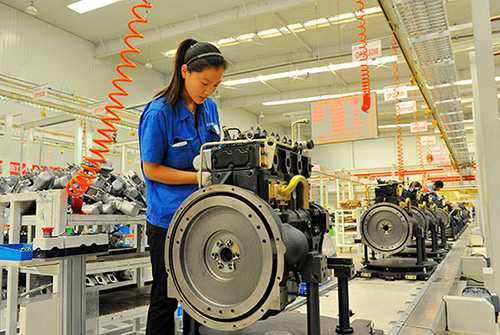
China's domestic migrant labor force could power consumer spending growth in the world's second biggest economy if workers had better access to basic welfare services in the cities where they live and work, a new government report says.
The 230 million-strong migrant workforce drives China's economy, but a lack of access to education, health and other services tied to the country's strict household registration - or hukou - system forces massive saving, restraining Beijing's efforts to shift growth's focus to consumption from investment.
"Giving the migrant population living in cities permanent status and giving them equal access to fundamental public services would greatly stimulate China's consumption growth," the National Population and Family Planning Commission said in its latest annual report.
Consumption-driven growth is regarded by many economists as a more stable development model for China than the investment-driven path trodden so far, which the International Monetary Fund says stokes over-capacity and inefficiency.
Beijing sees the rise of consumers as the key driver of growth for a generation to come in the wake of the massive urbanization of the last three decades that lifted an estimated 600 million people from poverty and turned China's export-focused factories into the new workshops of the world.
China's migrant workers in their millions flood into cities each year from the impoverished countryside. They are relatively low paid, but have earned annual double-digit pay rises for years, making them a huge potential source of consumer spending.
Migrant workers spent an average of 56 percent of the salary increases they earned in 2011, according to data in the report.
It showed that monthly spending per capita rose by 230 yuan ($36) in 2011 from a year ago based on average pay increase of 406 yuan to 2,253 yuan a month.
Migrant workers living in any given city for one year spent 1,761 yuan on average, increasing to 2,609 yuan if they stayed for five years or longer, the report said.
The report found only 23.1 percent of Chinese migrants had pension insurance in the city in which they lived in 2011, 13.6 percent of them were covered by unemployment insurance and 64.3 percent had medical insurance.
That forces migrants into massive precautionary saving to pay market rates for services in cities.
City dwellers covered for six basic welfare services typically spend 1.4 times as much as those who are not, the report found.
The report forecasts China will have 250 million migrant workers by 2015, 190 million without access to welfare services.
Some economists say China's pool of low-cost labor is quickly drying up, pushing the country close to a turning point where wages are set for rapid gains.
However, the report said China's labor supply would continue to be abundant with the workforce reaching 885 million in 2050, albeit decelerating from a peak of 1 billion-plus, forecast to arrive in 2016.

Copyright 1995 - . All rights reserved. The content (including but not limited to text, photo, multimedia information, etc) published in this site belongs to China Daily Information Co (CDIC). Without written authorization from CDIC, such content shall not be republished or used in any form. Note: Browsers with 1024*768 or higher resolution are suggested for this site.
License for publishing multimedia online 0108263 Registration Number: 130349