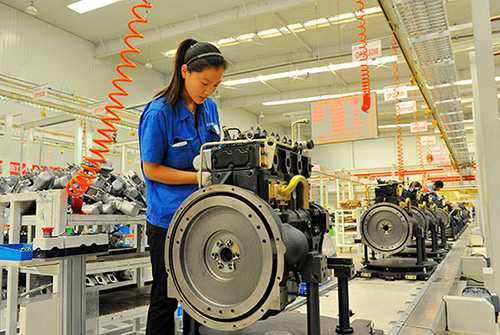
The Brazilian government also has localization regulations in force that mean if a foreign company wants to hire one Chinese worker, it must hire two local workers as a trade-off.
Sany currently has 345 employees in Brazil, 280 of which are local people, far above the stipulated localization ratio.
But having met the localization requirements, working visas are also still hard to apply. Even in cases of Chinese people hired in Brazil, all the necessary materials must be sent to the embassy back in China.
The application procedure can take months, and that's provided everything goes smoothly.
For a machinery manufacturer such as Sany, it is vital to have a skilled workforce, and their Brazilian employees at the production lines are in need of training by their Chinese counterparts.
"We cannot have the skilled Chinese workers we need in the workshop without working visas. But the application procedure consumes too much time, and often disrupts our schedules," Xu said.
Even top-level management can face the same dilemma.
Xu himself is waiting for his working visa to go to Brazil. A business visa grants people entry to the country, but they are still not allowed to work there.
The lack of management experience in Latin America poses another potential snag for Chinese companies.
Language and culture are a problem to begin with, and students in China studying Portuguese and Spanish remain a minority compared with the widely taught English.
In many Chinese companies, simple unfamiliarity with Latin culture can lead to avoidable disputes between local and Chinese employees.
In some extreme cases, the cultural barrier has affected business efficiency.
Most Chinese companies that achieved success in overseas markets mainly rely on their ability to respond fast to the local market's demands and provide products with decent quality and a reasonable price.
But compared with their rivals from Europe and the United States, Chinese companies need to improve their internal communications.
Adenilson Carvalho, head of human resources at Sany in Brazil, pointed out that some US companies are able to easily put employees of different nationalities into departments of different functions.
"But Chinese companies need to cross a wider cultural gap than US companies," he said.
Huge market potential and strong economic growth, especially at a time when the advanced economies such as the European Union and US are struggling with a sluggish economic recovery, make Latin American markets enormously attractive.
And so, despite the challenges posed by the investment environment and cultural barriers, Chinese companies still appear determined to stay and succeed in Latin America.

Copyright 1995 - . All rights reserved. The content (including but not limited to text, photo, multimedia information, etc) published in this site belongs to China Daily Information Co (CDIC). Without written authorization from CDIC, such content shall not be republished or used in any form. Note: Browsers with 1024*768 or higher resolution are suggested for this site.
License for publishing multimedia online 0108263 Registration Number: 130349