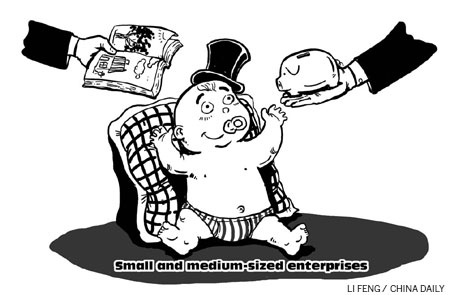
Small and medium-sized enterprises are the powerhouses in most economies. But with many SMEs experiencing a squeeze on credit in the wake of the financial crisis, public debate has quite rightly focused on the need to get banks to lend more to this dynamic sector.
A 2011 report by the International Finance Corporation estimated that as many as 85 percent of SMEs worldwide suffer from credit constraints. Lack of finance is clearly a serious impediment to the development of SMEs, preventing them from playing their full role as engines in the economy.
Yet focusing exclusively on the availability of loans to help SMEs thrive and produce jobs would be misguided and could limit their growth potential.
In our experience, as a bank working with over half a million businesses and entrepreneurs in Asia, Africa and the Middle East, SMEs need support on a number of levels, not just loans, in order to reach their full potential.
A significant number of SME owners may lack expertise in areas such as accounting, cash management, business planning, human resource management and marketing. Without these essential business skills, many viable companies with good products will never reach their full potential or they might fail altogether, succumbing to competition and poor cash flow management.
SMEs that lack business skills may be unable to obtain bank financing because they cannot produce the financial records required, or they may fail to make the most of the financing they do obtain. Either way, a potentially great contribution to growth and job creation is wasted as the business fails to flourish.
Banks can certainly play a wider role in supporting SMEs, not just by providing credit, but by helping to build up the capacity and resilience of SMEs through non-financial services, such as training, consultancy, mentoring, networking and knowledge sharing.
There is no doubt that helping SMEs to improve their knowledge and business skills has a positive knock-on effect on their competitiveness and ability to obtain financing. Ultimately it is also good for banks, as the SMEs become better customers, improving their growth potential and ability to repay loans.
In Pakistan where Standard Chartered partnered with the International Finance Corporation to train SMEs in essential business skills three years ago, more than half of the participants subsequently improved their financial reporting, budgeting and financial decision making. Of those who had previously had irregular credit histories, 70 percent had cleared or reduced their debt by the end of the training.
One very obvious positive outcome of such training programs is that the SMEs become more able to obtain financing to grow their businesses. More than half of the SMEs participating in our courses in Africa subsequently obtained new credit facilities. An average of 69 percent also claimed to have improved their cash flow and general financial management.
Scaling up such training programs to reach large numbers of SMEs globally can be a challenge, but there are also plenty of other non-financial services banks can provide to support SMEs.
For instance, many SME owners have limited knowledge of the different bank products and services that might help their business grow. Banks can address this by offering dedicated product specialists in areas such as trade, cash management and investment, who can explain the solutions on offer and how they can support SMEs to improve their efficiency.
Gathering and sharing knowledge and resources for SMEs in an easily accessible format is another obvious role for banks. In a survey of SMEs which we conducted across six of our key markets last year, more than half of respondents identified knowledge sharing as a service they would benefit from. Banks can do more to close this knowledge gap.
According to the International Finance Corporation, more and more banks working in emerging markets are now starting to offer non-financial services in addition to more traditional financial services, realizing the business benefits of this more holistic approach to serving SMEs.
Underpinning this sentiment is a fundamental shift in how banks work with SME customers, from a purely transactional relationship to one in which the bank becomes an advisor and trusted partner. Stable, comprehensive, long-term banking relationships benefit not only SME customers, they benefit banks too.
Traditionally, SMEs have been seen by banks as risky and costly to serve. With a changed approach, focusing on addressing the overall business needs of SMEs, not just selling financial products, this assumption can be turned on its head.
The author is global head of SME banking, Standard Chartered Bank.

Copyright 1995 - . All rights reserved. The content (including but not limited to text, photo, multimedia information, etc) published in this site belongs to China Daily Information Co (CDIC). Without written authorization from CDIC, such content shall not be republished or used in any form. Note: Browsers with 1024*768 or higher resolution are suggested for this site.
License for publishing multimedia online 0108263 Registration Number: 130349