|
 |
|
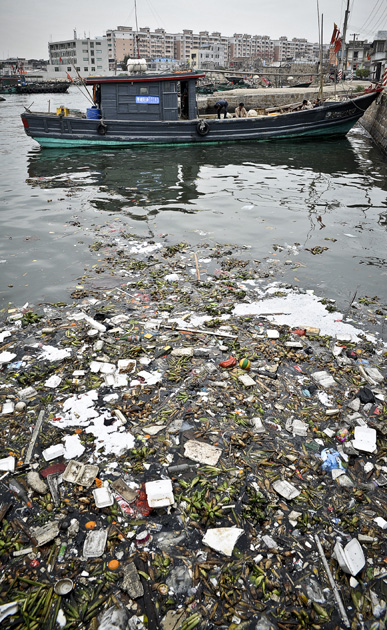
Rubbish is piled up on the surface of Lianhe River, Guangdong province, in April. [Photo/Yangcheng Evening News] |
Nearly 76 percent of the sewage generated in Guangdong province last year was directly discharged into local rivers, the province reported on Monday.
The Guangdong Provincial Department of Water Resources published the findings in the Bulletin of Guangdong's Water Resources in 2011.
The amount of sewage discharged in the southern province reached 12.53 billion metric tons in the previous year, up 110 million tons from 2010, the bulletin reported.
Industrial wastewater represented 55 percent while domestic sewage accounted for the remaining 45 percent of the sewage discharged in Guangdong in 2011.
More than 9.5 billion tons of the sewage, or 75.8 percent of the total, was directly discharged into local rivers, the bulletin said.
The major river systems in Guangdong are the Pearl River Basin, the Hanjiang River Valley, and rivers in the eastern and western parts of the province. According to the year-end report, the water quality of rivers in eastern Guangdong is the worst, with 30 percent of them heavily polluted.
Because of the serious pollution, the water quality of major rivers within Guangdong province is poor, threatening the health of local residents who live along the province's riverbanks, the bulletin said.
And the water quality has become even worse in the Pearl River Delta region, which borders Hong Kong and Macao.
More than 54.8 percent of the sewage that has directly been discharged into rivers in 2011 was reported in the affluent Pearl River Delta, one of the economic engines on the Chinese mainland.
The cities of Guangzhou, the Shenzhen special economic zone, Dongguan and Foshan each discharged more than 500 million tons of wastewater into local rivers annually, according to the bulletin.
Wang Xiaojun, a professor of environmental engineering at South China University of Technology, said the bulletin by the provincial department of water resources indicated that government departments in the province still have a lot of work to do to meet their goals of curbing Guangdong's water pollution in the coming years.
"Relevant governments should expand investment in building and maintaining sewage-treatment plants, sewage networks and pipelines in the future," Wang told China Daily on Monday.
"The province could realize its target on sewage treatment if relevant departments will spare no efforts to tackle water pollution and invest more in the industry," he said.
He attributed the province's worsening water pollution to the lack of investment in sewage treatment in some areas, particularly in the under developed and remote cities and counties in western, northern and eastern parts of the province.
Chen Guangrong, deputy director of the provincial department of environmental protection, said the Guangdong provincial government has promised to improve the water quality over a larger area in the future.
Chen said Guangdong will increase its daily sewage treatment capacity by 1 million metric ton this year and build another 1,000 kilometers of sewer networks.
"Our goal is a daily sewage treatment capacity of 22 million tons and 12,000 kilometers of sewerage networks by 2015," Chen said.
"Apart from the Pearl River Basin, we will also work on improving the water quality of the Hanjiang River Valley and the tributary rivers in eastern and western Guangdong," Chen said.
zhengcaixiong@chinadaily.com.cn

Copyright 1995 - . All rights reserved. The content (including but not limited to text, photo, multimedia information, etc) published in this site belongs to China Daily Information Co (CDIC). Without written authorization from CDIC, such content shall not be republished or used in any form. Note: Browsers with 1024*768 or higher resolution are suggested for this site.
License for publishing multimedia online 0108263 Registration Number: 130349