|
 |
|
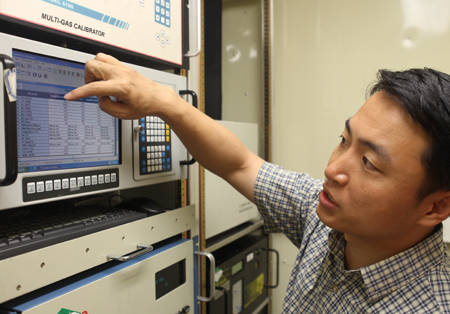
Wei Qiang of Beijing Municipal Environmental Monitoring Center, with a PM10 monitor. [Photo/China Daily] |
Wu Xiaoqing, vice-minister of Environmental Protection, said China will invest more than 2 billion yuan to build up the number of sites to monitor air quality to 1,500 before 2015.
"Our standard says there should be one monitoring site every 25 to 30 square km. That's also the requirement in other countries," said Wu. "We will get closer to that by adding 800 monitoring sites to the current 600-odd nationwide by 2015. We are doing so in pursuit of a more thorough, objective and accurate evaluation of our air quality."
Ma Jun, head of the Beijing-based Institute of Public and Environmental Affairs, said the current target set for China is in accordance with the level of economic development. "It's important that the government describes air quality in a realistic way, for example by not using the phrase 'slightly polluted' to enhance the prestige of the official data, when it is obvious to everyone that the level is high," said Ma.
Moreover, the standard for national air quality, published in 2007 and including limits on PM2.5, was formulated too quickly, and it may be difficult to reach the goals it set out to achieve, according to Peng Yan, the China representative of the Manila-based Clean Air Initiative for Asian Cities, a network of governments, the private sector and NGOs.
Peng said the layout of monitoring sites in the 2007 air quality monitoring standard failed to take into account the vast numbers of people engaged in outdoor activities, especially those groups especially vulnerable to poor air quality, and suggested that they should be updated regularly.
"To evaluate whether a monitoring site is located reasonably, whether in the parks or on the street, is not important, as long as it is in accordance with the regular patterns of outdoor activity," said Peng, who suggested that the monitoring standards should be updated to meet the new air quality standards, so that improvements can be promoted steadily.
The US established a national ambient air quality standard for PM2.5 in 1997. The average over each 24-hour period was set at 65 mcg per cu m, with an annual average of 15 mcg per cu m. The standard was revised in 2006 and the 24-hour average became more stringent, being reduced to 35 mcg per cu m, while the annual average remained unchanged. The revision was based on evidence about the deleterious effects on health of fine particles that was unavailable before 1997.
"The reasons behind the changes to the PM2.5 standard in the United States were new information and greater concern about the effects of PM2.5," said Harley from the University of California. "It would be helpful to better understand which components of PM 2.5 are the most toxic to people's health. And then the control efforts and monitoring could be targeted at the sources and pollutants that cause the most harm."
Contact the reporters at pengyining@chinadaily.com.cn, huyongqi@chinadaily.com.cn or wuwencong@chinadaily.com.cn


Copyright 1995 - . All rights reserved. The content (including but not limited to text, photo, multimedia information, etc) published in this site belongs to China Daily Information Co (CDIC). Without written authorization from CDIC, such content shall not be republished or used in any form. Note: Browsers with 1024*768 or higher resolution are suggested for this site.
License for publishing multimedia online 0108263 Registration Number: 130349