|
 |
|
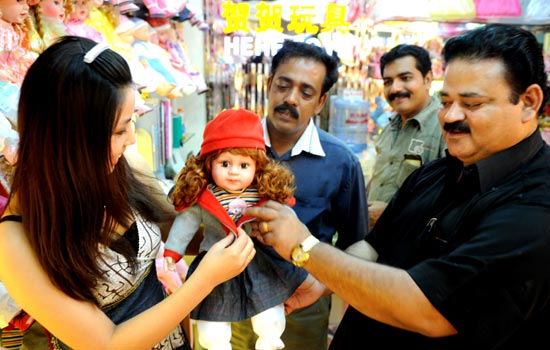
This 2011 photo shows Indian businessmen purchasing Christmas products in a local international trade center in Yiwu city, Zhejiang province. [Photo/China Daily] |
Commercial disputes can easily occur between different cultures, reports Xu Junqian in Yiwu.
Gulshan S. Asnani's office is decorated with a small woolen wall carpet featuring exotic patterns from his hometown in India and a man-sized Malabar chestnut, or money tree, a pot plant the Chinese believe will bring good fortune.
These weirdly matched items symbolize the way the 35-year-old trader has been conducting business for the past decade in the city of Yiwu, Zhejiang province. He's combined a touch of India, which, as he sees it, is boldness, with the Chinese characteristics of diligence, intelligence and, perhaps, a little bit of cunning.
Asnani has always been proud of this "When in Rome" attitude, which has helped him develop a multimillion-yuan company. That is until recently, when what the locals call the "Indian thing" occurred.
"The attitude of the Chinese businesspeople in the market has changed totally. They have become as wary as cats, especially once they know that you are from India," Asnani said.
The "Indian thing" was highlighted in May, when a trader called Danish Qureshi was illegally detained at the apartment of a Chinese woman named Wang over a debt dispute. According to the Hindustan Times, Qureshi's employer, an Indian businessman called Faisal, had defaulted on service fees of 50,000 yuan ($8,000) and on payments for purchased goods of 400,000 yuan owed to Wang. Quareshi was discovered and freed by local police after three days, and Wang was detained.
The incident gained wide attention within the business community. Two days after Qureshi's rescue, the Indian embassy in Beijing issued a safety advisory notice "cautioning" Indian businesspeople against doing business in Yiwu and warning of dangers such as "curtailed freedom of movement".
In the past two decades, Yiwu has developed from an obscure town with neither geographical nor natural advantages into the world center for small commodities such as hair clips and zippers. That growth has attracted traders from around the world, looking to ship cheap Made in China goods back to their home markets.
Government statistics show that more than half of Yiwu's population of just under 2 million are non-native residents. The number of foreigners is 13,000 from 197 different countries, outstripping the overseas populations of other large cities in the province such as Hangzhou and Ningbo. More than half of the foreign residents are of Middle Eastern origin, from places such as Yemen and Egypt. The city also plays host to a transient population of 420,000 foreign businesspeople.
The advisory notice was the second the Indian embassy issued this year. In January, two Indian businessmen were held in similar detention by their Chinese suppliers and, according to the newspaper India Today, "are still fighting their case".
While the advisory has not been "taken seriously" by Asnani and many others in Yiwu, both Chinese and foreign entrepreneurs in the city have been dealt a heavy blow. "It reminded us that there seems to be something wrong with the apparently perfect chain of foreign traders and Chinese suppliers", said a Yiwu producer of accessories, who would only gave his surname as Zhou.
"The city's growing reputation has not only brought more deals, but also frauds from all over the world who want to make easy money. Moreover, some Chinese manufacturers have been too desperate to seal deals with traders, leaving many loopholes," he added.
To survive in the ever-competitive market, a supplier would sometimes agree to manufacture thousands of items without asking for a deposit, or would allow previously unknown traders to ship products home and settle the account at a later date.
Asnani shared Zhou's opinion. He said that problems of this type are always likely to happen "sooner or later" if business continues to be conducted in an "unbusiness like manner".

Copyright 1995 - . All rights reserved. The content (including but not limited to text, photo, multimedia information, etc) published in this site belongs to China Daily Information Co (CDIC). Without written authorization from CDIC, such content shall not be republished or used in any form. Note: Browsers with 1024*768 or higher resolution are suggested for this site.
License for publishing multimedia online 0108263 Registration Number: 130349