|
 |
|
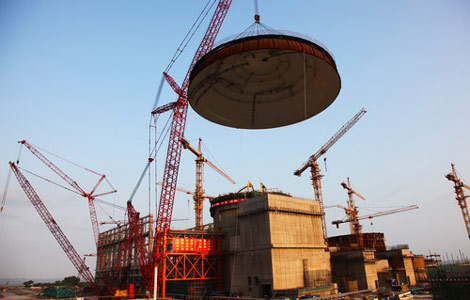
A dome is hoisted onto a reactor at a nuclear power plant in Fangchenggang, a city in the Guangxi Zhuang autonomous region. China is scheduled to begin approving new nuclear power plants next month after it conducted national safety inspection of the plants in response to a nuclear accident in Japan last year. [Photo / For China Daily] |
China is expected to resume the expansion of its nuclear power sector next month, with many plans reaching the final approval stage, according to Xu Yuming, deputy secretary-general of the China Nuclear Energy Association.
"The new approvals, however, will move much more slowly than before the Fukushima nuclear crisis last year," Xu said.
China suspended new nuclear projects after last year's earthquake and tsunami in Japan crippled the Fukushima Daiichi plant and prompted a global review of atomic energy plants.
China approved eight to 10 reactors each year between 2008 and 2010.
"The delay in new project construction has severely affected China's nuclear industry. Preliminary work on new sites stalled, while the manufacturing of key components has been delayed as new orders slumped," said Xu.
China had spent as much as 30 billion yuan ($4.7 billion) in upgrading its nuclear industry, including the manufacturing end, before the Japanese accident.
But over the past 14 months, no new projects have been approved or started construction.
However, by the end of this year, two new reactors - one in Hongyanhe, Liaoning province and one in Ningde, Fujian province - will go into operation, Xu said.
On March 16 last year, after the accident in Japan, the State Council announced that it would suspend approval of nuclear plant construction and ordered safety inspections at all plants.
China had 11.3 gigawatts of nuclear capacity at the end of 2011, with another 26 reactors, or 29 gW, under construction.
The government passed the National Nuclear Contingency Plan in April, an indication that it is getting closer to resume new project approval.
Xu predicted that China will have 70 gW of installed capacity by 2020, with another 30 gW under construction.
Before the Japanese quake, China had planned to increase its nuclear-generation capacity by about 10 gW annually to 80 gW by 2020, or by eight reactors each year.
Constraints on the industry include staff training, which usually takes four to eight years.
"China has about 1,000 nuclear experts now but will need 4,000 by 2020," said Donald Hoffman, president of Excel Services Corp, a US-based nuclear regulatory and engineering services provider.
"Nuclear power is still immature compared with other electricity sources," according to Steve Kidd, deputy director-general of the World Nuclear Association. He added that the Fukushima accident had driven up the cost of building new reactors.
According to Kidd, one challenge to the industry is that there is no established international chain.
Future growth in the nuclear industry will mainly come from Asia, especially from China, which will build 40 percent of the world's new reactors.
The WNA will soon open a new office in Beijing, Kidd said at the 8th China Nuclear Energy Congress.
liuyiyu@chinadaily.com.cn

Copyright 1995 - . All rights reserved. The content (including but not limited to text, photo, multimedia information, etc) published in this site belongs to China Daily Information Co (CDIC). Without written authorization from CDIC, such content shall not be republished or used in any form. Note: Browsers with 1024*768 or higher resolution are suggested for this site.
License for publishing multimedia online 0108263 Registration Number: 130349