BEIJING - Although some feared the possibility of a hard landing after China posted lower-than-predicted quarterly growth, the economy may rebound more quickly than expected as a result of robust inner growth dynamics, according to several global economists.
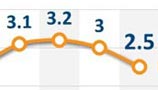
Dragged down by sagging exports and domestic tightening efforts intended to curb inflation, China's GDP growth hit an 11-quarter low of 8.1 percent in the first quarter of 2012, well below expectations of 8.3 to 8.5 percent.
"I don't think China will have a hard landing. There is still sufficient robustness in the Chinese economy," said John Quelch, dean and vice president of the China Europe International Business School.
Heading for rebound
With the key growth drivers of trade and investment showing signs of regaining strength and consumption expanding after the softening of inflation, economists believe China's growth will rapidly pick up rather than suddenly fall.
"Growth will rebound in the second quarter. The chance for a hard landing is slim," said Tang Jianwei, an analyst at the Bank of Communications.
"The economy will keep a reasonable growth rate as long as the government properly handles its macroeconomic control measures," he said, forecasting growth of 8.6, 8.7 and 9 percent, respectively, for the next three quarters.
Tang said he expects export growth to recover in the second quarter, as export orders have increased amid an improved global economic outlook.
Pressure on the yuan to rise sharply has eased following the introduction of a wider trading band, which has helped to reduce exchange costs for exporters.
Meanwhile, fixed-asset investment will grow at a slightly faster pace on the back of rapid investment growth in central and western China, he said.
Tang said he doesn't expect investment in the property sector to decline sharply, a possibility many believed to be the biggest uncertainty clouding the future of the economy.
Government investment will also increase, particularly for infrastructure and environmental protection projects, Tang said.
Moreover, domestic consumption will expand steadily, boosted by government policies to spur demand, as well as higher household incomes and falling consumer prices, he added.
Official data showed that the incomes of both urban and rural dwellers grew faster than the economy in the first quarter due to government efforts to increase the minimum wage. The inflation rate eased to 3.8 percent during the period, down from 5.4 percent in 2011.
Jing Ulrich, managing director of JP Morgan Chase, said China's growth may have hit bottom in the first quarter and will tick higher in subsequent quarters.
Ulrich said she expects more monetary fine-tuning to buoy the economy, including two to three cuts in banks' reserve requirement ratios this year after two similar cuts over the past five months and a lending jump in March.
She said the economy will expand by 8.4 percent this year, higher than the 7.5-percent growth target set by the Chinese government and the 8.2 percent forecast by the International Monetary Fund.
Upbeat long-term outlook
Most economists projected China's growth to trump the government's 7-percent target for the next five years, as the country's domestic policies will support more sustainable growth.
"The principal advantage that China has is its huge domestic market," Quelch said in an exclusive interview with Xinhua on Saturday.
Despite rapid growth over the past few decades, China's per capita GDP is still far less than that of most developed economies, indicating great potential for consumption and infrastructure construction.
"I think across a whole range of services and product industries, there is enormous upside potential for growth in China," Quelch said.
"I think the degree to which the domestic consumption will pick up will offset the effects resulting from softening export demand," he said.
China's urban population, which outnumbered that of rural areas for the first time at the end of last year, is expected to account for 70 percent of the total population by 2030, according to an estimate from World Bank President Robert Zoellick.
An increase of a single percentage point indicates an addition of more than 10 million urban residents, each of whom will spur at least 100,000 yuan ($15,873) in infrastructure investment, said Zheng Xinli, vice chairman of the China Center for International Economic Exchange.
Quelch said boosting consumption will require the creation of a social safety net and an adequate public health care system in order to cut savings ratio.
With the reduction of its 2012 growth target to 7.5 percent and increased fiscal spending on people's well-being, the Chinese government has indicated that it has abandoned the "grow at all costs" approach, focusing more of its energy on boosting domestic consumption.
While delivering a government work report in March, Premier Wen Jiabao vowed to improve government policies designed to boost consumption, expand China's social safety net and further promote income distribution reform.

Copyright 1995 - . All rights reserved. The content (including but not limited to text, photo, multimedia information, etc) published in this site belongs to China Daily Information Co (CDIC). Without written authorization from CDIC, such content shall not be republished or used in any form. Note: Browsers with 1024*768 or higher resolution are suggested for this site.
License for publishing multimedia online 0108263 Registration Number: 20100000002731