Vice-premier vows better services as hospitals see funding change
The funding of public hospitals through medicinal drug sales will be scrapped in some county-level hospitals this year, as Vice-Premier Li Keqiang called to make basic medical services a "public product" for all Chinese citizens.
Healthcare reform will overcome any challenges, Li said.
Efforts must be made to "expedite the development of the medical insurance system, expand the coverage of the basic healthcare network and raise healthcare subsidies", he said.
His remarks came after the State Council on Wednesday released a 2012 reform plan.
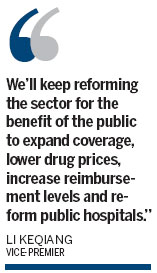
Despite what China has achieved, nearly universal healthcare, "we'll keep reforming the sector for the benefit of the public to expand coverage, lower drug prices, increase reimbursement levels and reform public hospitals", Li said.
The plan foresees that within the year 300 county-level hospitals will see a change in their funding.
This means the scrapping of a decades-old practice that saw them depend on drug sales for income.
"This is a preliminary step to reform public hospitals, particularly large city hospitals," said Wu Ming, director of the health policy and management department at Peking University. Wu is also a member of the expert panel for the Ministry of Health.
"The initiative at selected county-level hospitals will help build experience to reform public hospitals in urban areas," Wu said.
County hospitals mainly receive rural patients and are under the control of local health departments, making reform much easier, she explained.
However, urban public hospitals "require cooperation with other agencies like finance, human resources and social security", she added.
The current practice of funding stems from the government allowing hospitals to earn revenue by selling medical drugs.
The government now covers about one-fifth of total public hospitals' operation costs.
However, problems arose at some hospitals where doctors tended to prescribe expensive, and even unnecessary drugs, for profit, said Wu Mingjiang, deputy director of the Chinese Medical Association.
Chen Zhu, the minister of health, also recognized problems.
"Overemphasis on a market orientation does not suit the nature of China's socialist system and the medical sector," he told the People's Daily earlier.
To correct that, Li pledged to separate medical services from drug management and increase doctors' income.
Wang Jianye, vice-president of the Beijing Hospital, however, pointed out that without a compensation mechanism, the system will be hard to change.
According to the 2012 plan, a complex approach will be introduced: public hospitals will be financed by increasing government subsidies and adjusting the price of medical services.
Currently, "medical workers are underpaid", said Wu Mingjiang.
For instance, a course of acupuncture treatment costs only 4 yuan (63 US cents) in public hospitals.
But even if prices are raised, that doesn't necessarily lead to rising medical bills for patients, he said.
To date, more than 95 percent of Chinese citizens are covered by some form of medical insurance, official statistics showed.
The government has invested thousands of billions of yuan, particularly in rural areas, to enhance medical capacity and service access, Chen said.
shanjuan@chinadaily.com.cn


Copyright 1995 - . All rights reserved. The content (including but not limited to text, photo, multimedia information, etc) published in this site belongs to China Daily Information Co (CDIC). Without written authorization from CDIC, such content shall not be republished or used in any form. Note: Browsers with 1024*768 or higher resolution are suggested for this site.
License for publishing multimedia online 0108263 Registration Number: 130349