|
|
|
 |
|
|
|||||||||
Chinese manufacturers are capable of producing showcase equipment
Chinese companies will be ready to take a type of nuclear reactor known as AP1000 to market by the end of 2012, industry experts said.
Equipment manufacturers such as Shanghai Electric Group Co Ltd, Dongfang Electric Corp and Harbin Electric Corp are now capable of making five AP1000 reactor units a year, said Wang Baozhong, vice-president of China First Heavy Industries Co, which makes equipment used in the mining and energy industries.
 |
|
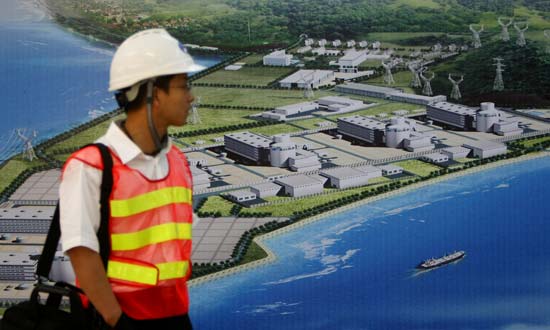
A journalist passing an artist's impression of the Sanmen Nuclear Power Plant in Sanmen, Zhejiang province.?[Photo/Agencies] |
"Our production capacity has already surpassed developments in the industry," Wang said. "But we are still falling behind in cost and in process controls."
Yu Zusheng, a nuclear industry expert, had similar thoughts.
"Chinese manufacturers are capable of producing showcase products but are not ready for mass production yet," Yu said.
Putting quality and safety first can cause delays in a project, according to Tim Collier, Westinghouse Electric vice-president and managing director for China.
Twenty years ago, Westinghouse placed its highest priority on manufacturing equipment on schedule, he said. Now, though, the emphasis is on ensuring quality.
Westinghouse Electric Co is the original developer of the AP1000 technology.
China now has four AP1000 reactors under construction, two in Zhejiang province and two in Shandong province. The technology was introduced by the State Nuclear Power Technology Corp Ltd in 2006.
The transfer of AP1000 technology is by far the most significant high-tech energy program between China and the US, worth an estimated 3.3 billion yuan ($520.9 million), according to the State Nuclear Power Technology Corp Ltd.
Since being introduced, the AP1000 has undergone several design changes, causing China's first projects involving that technology to be halted several times.
"Chinese culture concentrates on flexibility but, in the nuclear industry, flexibility really isn't an asset," Wang said. "You have to follow the guidelines strictly."
China is strengthening its nuclear technology and manufacturing capabilities and is expected to be able to generate 80 gigawatts of nuclear energy by 2020, up from 11.3 gigawatts now.
The country is also expected to start using AP1000 nuclear technology on a large scale to help ensure the safety of its future nuclear power plants. That change has been prompted in part by the safety concerns that arose following the crippling of Japan's Fukushima Daiichi power plant a year ago.
Statistics from the State Nuclear Power Technology show that 50 percent of the components needed for China's AP1000 demonstration projects can be produced domestically. After that, China is expected to be capable of producing 80 percent of the main components and materials used in the technology, according to the corporation.
The corporation, meanwhile, is also developing CAP1400, which is meant to be safer and cheaper to build than AP1000. The first demonstration project of CAP1400 is scheduled to take place in March 2013 in Rongcheng, Shandong province.
liuyiyu@chinadaily.com.cn