Global double-dip unlikely, Zhu says
Updated: 2011-09-15 07:48
By Hu Yuanyuan and Zhang Xiaomin (China Daily)
|
|||||||||||


|
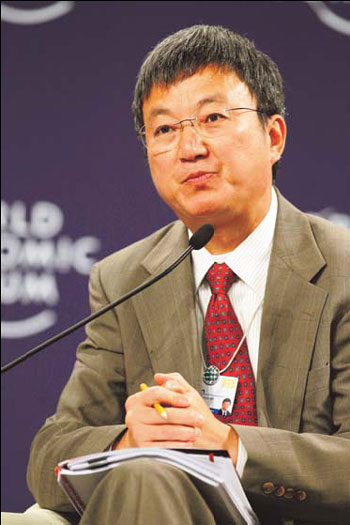
Zhu Min, deputy managing director of the International Monetary Fund, says the world economy is not likely to slip into a double-dip recession. [Photo / China Daily] |
High liquidity in developed nations could 'hurt' emerging economies
DALIAN, Liaoning - The world economy is not likely to suffer a double-dip recession, but developing countries should further tighten their monetary policies to keep inflation under control, Zhu Min, deputy managing director of the International Monetary Fund, said on Wednesday.
"There is no structural impact so far, as both developed economies and emerging countries just saw a growth slowdown instead of a negative one," Zhu said when attending the World Economic Forum in Dalian, Liaoning province.
However, the possibility for the world economy to slide into recession cannot be ruled out, and market volatility will continue, Zhu added.
To reduce double-dip risks, Zhu said, emerging economies should make more effort to stimulate domestic consumption.
Developed countries should encourage individual consumption and investment.
Meanwhile, ensuring a sound banking system is a top priority for governments in developed and developing countries, Zhu said.
"The EU countries and the US should take decisive measures right now to prevent the sovereign debt crisis from expanding to the banking system," Zhu said.
Besides, the growth of emerging economies is now largely driven by loan growth, meaning higher risks for the banking sector.
According to Zhu, new loans are becoming less effective in generating GDP. For example, in China before 2007, each yuan of new lending generated an equal amount of GDP. But last year, it took 2 yuan to generate each yuan of GDP, he said.
He said the ratio of new lending needed to generate GDP was even higher in other emerging markets such as India or Turkey.
An interesting aspect of the current global turmoil, Zhu said, is that the linkage between the developed economies and the emerging ones has been largely reduced, reaching a record low for the past 50 years.
"But developing countries should still take timely measures to prevent potential risks, such as continuing to tighten monetary policies to combat inflation," Zhu said.
Many countries are now in a low-interest-rate environment and international capital is chasing any lucrative investment opportunity. Such high liquidity, combined with rapid capital flows, could easily hurt developing economies, Zhu said.
The Asian Development Bank on Wednesday lowered its growth forecast for Asia's developing economies to 7.5 percent for this year, from a 7.8 percent forecast in April.
The bank said it lowered its forecast because worsening economic conditions in developed nations will weigh on export-focused Asian economies.
"Such a slowdown is healthy, as it is a result of governments' voluntary measures to keep inflation in check," Zhu said.
- Outstanding foreign debt climbs to $642.5b
- Standard for "high pure gold" set
- Vanishing property boom signals price decline
- BYD: How to 'build your dreams'
- China raises bar for fuel-saving car subsidies
- Huawei eyes enterprise deals
- China to curb chemical plants
- China extending pension program to countryside