Aging nation creates nursing home boom
Updated: 2011-12-05 09:09
By Tania Lee (China Daily)
|
|||||||||||


Increasing elderly population and burgeoning wealth open up market
BEIJING - Of all the unexpected things in Chinese society, moving into a nursing home is one of the most unusual.
|
 |
|
A senior citizen eats lunch beside a temple wall in Nantong, in East China's Jiangsu province. China's increasingly aging population has led to rising demand for nursing homes.[Photo/China Daily] |
Nursing homes in China may appear very large and glamorous on the outside, but sometimes what's on the inside reveals a totally different picture. Unlike those in some developed Western countries, experts say many nursing homes in China are overcrowded, receive inadequate government funding, have poor amenities and are often staffed by rural migrant workers with no professional training in the care of the elderly.
Chinese people feel ashamed or embarrassed to put their relatives "away" in nursing homes, but in many cases, it is the last or only resort.
The family structure in China is changing: Women, who once supported the family at home, have entered the work force in greater numbers. Chinese society has become much more educated. People who have better jobs and busier lives as a consequence are among those who have strayed from the strong tradition of filial piety and are thus helping to create the nursing home phenomenon.
This is where East meets West. Global investors have caught on to China's boom in care for the elderly. Given the country's enormous population, this socio-demographic shift symbolizes an opportunity for companies and investors to move into an increasingly lucrative and relatively untapped market.
The statistics
According to the National Bureau of Statistics, China now has more than 178 million people aged 60 or older, approximately 13 percent of the population. By 2042, the elderly will account for more than 30 percent of the population and China will have the biggest aging-society problem of any country in the world, exacerbated largely by its one-child policy. The average lifespan of a Chinese citizen is now 73 years.
"The main issue is not that the population will age - that's a given," said Gordon Orr, director at McKinsey & Co, a global management consultancy. "It's how the government can afford to pay older workers, in terms of pension and other healthcare benefits."
Local governments are discovering that demand far exceeds supply. In rural China, 40 million elderly people will be living on their own during the 12th Five-Year Plan period (2011-2015) because their children are working elsewhere, testing the country's social services and insurance system.
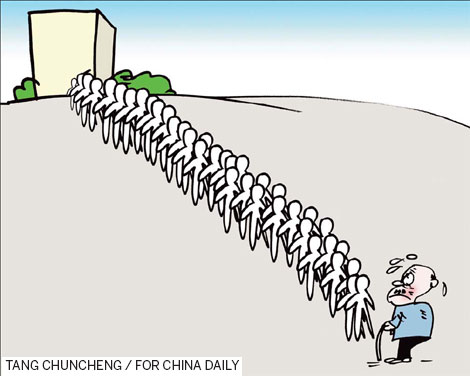
Wu Yushao, deputy director of the Office of China National Committee on Aging, says the situation poses a huge challenge for China. "Services for the elderly are too weak to handle the situation and the welfare system is still backward and a large number of senior citizens in rural areas are not included," the Xinhua news agency quoted Wu as saying.
Nonetheless, the majority of care homes in rural China are funded and, in most cases, operated by local governments.