China inflation eases to 5.5%, policy change caution urged
Updated: 2011-11-09 09:46
(Xinhua)
|
|||||||||||


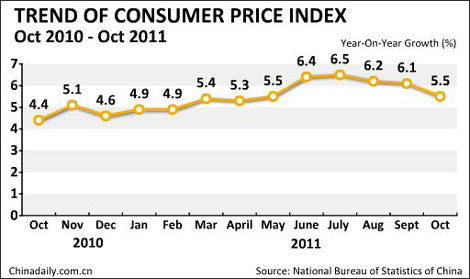
BEIJING -- China's consumer price index (CPI), the main gauge of inflation, rose 5.5 percent year-on-year in October, weakening from September's 6.1 percent, the National Bureau of Statistics (NBS) said on Wednesday.
The October CPI growth marked the slowest surge since May this year, softening from 6.1 percent in September, 6.2 percent in August, 6.5 percent in July and 6.4 percent in June.
"The October CPI data showed that the government's price control efforts have started to pay off," said Zhang Liqun, a macroeconomic researcher with the Development Research Center of the State Council, or China's Cabinet.
Zhang said the slowing price increases will create favorable conditions for the country to fine-tune its monetary tightening policies, although inflationary pressure will remain due to a large outstanding broad money supply (M2).
By the end of September, the gross M2 still stood at 78.74 trillion yuan ($12.4 trillion), about 1.8 times larger than China's gross domestic product (GDP). In 2008, it was only 1.54 times larger than the GDP, Zhang said.
"The size of the money supply remains huge and policymakers should be careful about (loosening) the monetary policy and not ignore its potential for boosting prices," he said. "It is a critical moment for the country's macroeconomic control policies and we can't be too careless in loosening the policies."
Prior to the NBS announcement, many economists expected the October CPI to rise by 5.4 percent year-on-year, still well above the government's full-year target of 4 percent.
Lu Zhiming, a researcher with the Bank of Communications, said October's slower growth in CPI and PPI was within his expectations.
Lu attributed the weakening inflation to price declines in farm and non-farm products and accumulated efforts of monetary tightening introduced in previous months, as well as commodity price drops amid the lingering European debt crisis.
"Prices are now on a downward trend and the CPI reading will weaken further in the fourth quarter, bringing the full-year CPI rate to around 5.5 percent," Lu said.
Over the next two years, the average inflation rate will fall to between 2.8 percent and 4 percent but the government should be vigilant in countering inflation risks in the medium and long term, he added.
On a monthly basis, the cost of living in October was still 0.1 percent higher than September, although it was still lower than the 0.5 percent month-on-month growth in September, according to the NBS.
Price weakening
On breakdown of the CPI calculations, food prices, which account for nearly one-third of the basket of goods used to calculate the CPI, moved up 11.9 percent in October from a year earlier but dipped 0.2 percent month-on-month, according to NBS data.
The slowing inflation reading buoyed Beijing residents like Wang Baorong, who was shopping for vegetables when the NBS released the data.
"The news is pretty good. I did feel the food prices were down a little bit," she said when making her orders at the Laoqianggen food market in downtown Beijing, "I can buy more celery and carrots with the same amount of money as month ago."
Liu Jiandang, a grocer at another market just a couple of miles away, said he had more room to bargain with customers on the price of vegetables he sold this month because the wholesale purchase prices were lower.
"Generally, vegetable prices are down," he said.
China's producer price index (PPI), a major measure of inflation at the wholesale level, rose 5 percent in October year-on-year, the slowest growth in a year.
The slowing PPI reading will offer support to the country's efforts to control inflation in November when producers passed on the smaller price gains to consumers.
Policy impact
Lu Zhengwei, chief economist of the Industrial Bank, said the October CPI figure was exactly in line with his forecast. But the 5.0-percent PPI growth was far below the bank's expectation.
"This is a clear signal that China's economy has succeeded in making a soft landing," said the economist.
Separately, in a report released shortly after the NBS announcement, the Bank of America Merrill Lynch (BoAML) predicted a big chance of the CPI year-on-year growth to fall below 5 percent in November and even to 4.6 percent in December, citing factors including "a rising comparison base and falling prices of food and energy."
"This data should be quite positive to market sentiments. As inflation worries ease, the room for fine-tuning monetary tightening is getting bigger," wrote Lu Ting and three other BoAML researchers in the report.
Even though policymakers might still put taming inflation as a top priority, the BoAML team see policies to be increasingly nudged towards pro-growth.
"But we don't expect a major change in monetary policy stance or some high profile moves such as cuts of policy rates and reserve requirement ratio (RRR). We think the chance of a system-wide RRR cut is still quite small as an RRR cut could send a too strong signal of changing policy stance," said the BoAML team.