Xinjiang's economy set to be transformed
Updated: 2011-09-15 13:45
By Cui Jia and Mao Weihua (China Daily)
|
|||||||||||


|
 |
|
Staff workers at the company monitor data in a central control room. [Photo / China Daily] |
Looking to the future
Thirty-one State-owned enterprises plan to invest 991.6 billion yuan ($155 billion) in Xinjiang from 2011 to 2015, bringing the total investment from such companies to 1 trillion yuan and doubling the amount they spent in the region between 2006 and 2010.
According to statistics released by the State-owned Assets Supervision and Administration Commission of Xinjiang, 44 central State-owned enterprises had invested 573.9 billion yuan by the end of 2010 into the petroleum and petrochemical, coal, power and metallurgical industries in the region. By the same date, they had made a profit of 55.2 billion yuan and paid 48.4 billion yuan in income taxes to the region. The companies also produced more than 70 percent of the value-added goods that came out of Xinjiang.
As an important strategic resource base in China, Xinjiang has long attracted investments from companies that are wholly or partially owned by the central government. Since China's adoption of its reform and opening-up policy in 1978 and its subsequent Great Western China Development Strategy, the region has taken advantage of its rich natural resources to attract large businesses and tried to become a place where State-owned enterprises will want to invest their money. To achieve that latter goal, it has adopted policies that give such companies preferential treatment, established industrial parks where they can obtain land for free and provided other accommodations. The strategy has proved an effective means of enticing large businesses to invest more and more in the region, Wang said.
Take the example of China Guodian, one of five companies supplying the largest amounts of electricity in the country.
"Guodian spent 20 billion yuan in Xinjiang from 2006 to 2010, and our contribution to the region will increase fourfold in the next five years," said Zhang Chenglong, manager of China Guodian's Xinjiang company.
Guodian plans to spend about 480 billion yuan on power projects in the country in the next five years. Xinjiang will receive nearly a fifth of that total, Zhang said.
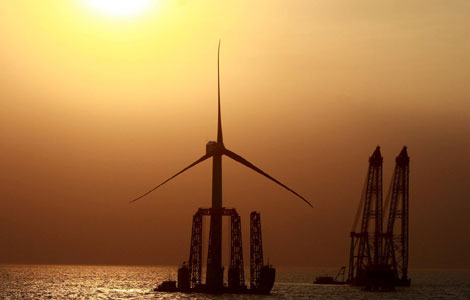
"Unlike in the past, our future plan for Xinjiang will be to develop clean energy such as wind power and hydroelectricity," he said.
Guodian's Xinjiang company makes profits of around 10 percent, while the corporation as a whole makes profits of 4 percent. Zhang attributed the subsidiary's better performance to the preferential treatment it receives under the region's taxation policies as well as the cheap labor it finds in the region.
"Investing in Xinjiang is now a national strategy that we follow," Zhang said. "Still, because of the region's markets and resources, enterprises that have the ultimate goal of making as much profit as possible would spend money in the region regardless. It's mutually beneficial to both the region and the corporations."
Of those who work for Guodian in Xinjiang, more than 80 percent are local residents. And more job opportunities will open in the region once work begins there on various power plants and wind farms. Most of the projects Guodian plans to undertake in Xinjiang have already won approvals from the National Development and Reform Commission. Construction will start on them in 2012.
In Xinjiang, affiliates of State-owned enterprises are registered as local companies to ensure that they pay taxes to governments in the region and that the taxes collected from their projects can be used to improve residents' livelihoods.