SIPO: Worldwide patent data crucial to China's innovation
Updated: 2011-09-14 15:58
By Wang Xin (China Daily)
|
|||||||||||


|
Tian Lipu, commissioner of the State Intellectual Property Office, makes his keynote speech at the China National Convention Center. [Photo / China Daily] |
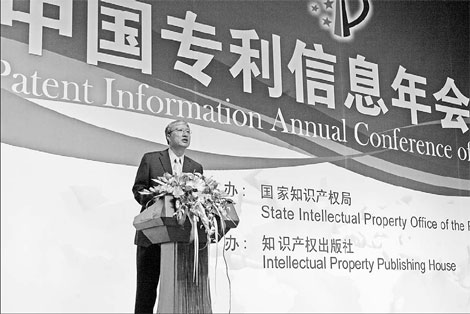
Companies need to recognize the importance of patent documents as part of their development strategy and use those resources throughout the entire innovation process, Tian Lipu, commissioner of the State Intellectual Property Office (SIPO), said at an annual meeting on patent information in Beijing last week.
The two-day seminar began on Sept 5 at the China National Convention Center.
"Efficient analysis and use of patent information helps to improve R&D, identify market trends, seize development opportunities and avert intellectual property (IP) risks," Tian said.
"As China is now upgrading industries, we attach high importance to patent information as strong support to revitalize traditional sectors and develop emerging industries," he noted.
SIPO will promote the growth of patent information services and encourage more institutions to join and meet the growing need, the commissioner said.
Randall Rader, chief judge of the United States Circuit Court of Appeals and also a law professor at George Washington University, told the seminar that his 120-student class includes nearly 20 from China.
One of his Chinese students said a patent system is created for "information disclosure", which Rader agreed is true because documents are written so other inventors, scientists or people skilled in the field know current developments.
"The documents may have a legal consequence, but they are really scientific documents," he said. "They are written to convey information so that we promote swifter development of science."
Fifty years ago, probably two or three research laboratories like Edison Lab could invent everything necessary around the world, but "that has changed", Rader said.
"It is no longer possible for any corporation, any company or any research institution to alone develop new technology," he said.
"In order to really advance technology, you must learn to cooperate," he said.
During his recent visit to Microsoft, he said he found brilliant computer scientists there were not just "sitting together and trying to alone design the future".
"Instead, they spent a great deal of time analyzing the world's advances," he said. "The information alone justifies the creation of a patent system."
An example of "magnificent international cooperation to advance technology and solve human problems", the patent system allows scientists worldwide to collaborate, the judge said.
Chen Luchang, director of the IP department at Sany Group, one of the largest Chinese machine and equipment makers, outlined his company's policies for using patent information.
The company has established its own IP website with a vast patent database, the majority of which is from the United States and Europe.
All the group's facilities worldwide have access to the database.
Key role
Chen said patent information plays a key role in various stages of production, from decisions on whether to start an R&D project and evaluating research results to tracing major advances by competitors and early warning about potential overseas IP risks.
To date, Sany Group has filed more than 3,000 patent applications. About one-third have been granted.
Compared with such large companies, small businesses are short of resources to use IP information.
Eiichi Yamamoto, deputy director of a planning department at the Japan Patent Office, said his operation offers companies access to a digital IP library that provides patent information and facilitates R&D by small businesses.
Founded in 1999, the online library with a free English version contains more than 80 million documents covering patents and trademarks.
Yamamoto said Japan values the combined services provided by the government and private sector.
The patent seminar also attracted scores of intermediary service providers, including those from Japan, South Korea, Britain, the US and Singapore.
The firms set up exhibition boosts outside the conference hall, where some presented their latest software.
With more than 70 million patents worldwide, professional intermediary organizations help to find the most valuable information and provide an abridged version, saving time for R&D staff, said Zhu Xinyu, patent information analyst at Intellectual Property Publishing House.
As well, analysis of patent information offers inspiration for further invention and aids innovation, Zhu said.
"A trend in the patent information industry is the increasing need for tailor-made services and segmented technologies," Zhu said. "That requires an all-round information service team."
Related Stories
Ericsson to sue ZTE over patent breaches: Report 2011-04-02 16:06
Massive surge in patent filings 2011-02-11 08:57
China 2010 international patent filings up 56.2% 2011-02-10 10:51
Lawsuits to grow as patent filings rise 2010-12-14 11:07
- Bun shops 'sneaking in banned additive'
- CBD fest to mark start of core project
- Premier Wen calls for financial stability in US
- Property prices will fall in next 12 months, HK developer Lo predicts
- Banking watchdog warns of P2P loan risk
- Italy bond purchase may be on the cards
- Ping An may invest in PE, property
- Sina says to ensure info authenticity