There's no reason not to tax e-commerce
Updated: 2011-08-29 10:54
By Teng Xiangzhi (China Daily)
|
|||||||||||


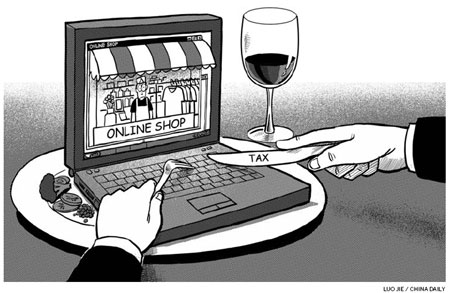
E-commerce is a commercial activity that uses the Internet as the transaction platform. According to China's tax law, people and businesses need to pay income tax, value-added tax and/or corporate tax if they sell goods, software and/or pictures or act as information consultants on the Internet.
Since e-commerce can be transnational, the tax law could face some tough problems. The first problem is erosion of the tax base. If buyers and sellers are based in different countries and if Customs duty and tax is not imposed on products flowing across national borders, a sovereign state could suffer the loss of tariff and value-added tax.
Second, it is hard to determine the nature of online trade and the income of online businesses. For example, since videos, pictures and books can be downloaded by customers, it is difficult to determine whether tax should be imposed on the profit disclosures or real sales.
And third, it is difficult to track the four elements - tax registration, account books, tax declarations and tax checks - on which tax collection and management is based when it comes to online businesses.
To deal with the three problems, some experts have suggested setting a new type of tax for e-commerce. For example, Australia which imports technology, products and services through the Internet on a large scale has devised a special tax policy for e-commerce based on income disclosure to prevent loss of tax. In the United Sates, the Internal Revenue Service has set rules for Internet trade, dividing the trade of copyright and transaction of products that involve copyright. These rules are good examples for China to learn from and set its own regulations.
From the legal point of view, although China's tax management and collection method are not mature enough to deal with online businesses, it does not necessarily mean tax cannot and should not be imposed on e-commerce.
The Wuhan tax bureau, for example, recently levied tax on a company's online transactions to apply the current added-value tax rules to e-commerce without changing or violating the tax law. There is thus no need for the National People's Congress (NPC) Standing Committee to start working on legislation aimed especially at e-commerce. Tax authorities can identify the constituent elements of the tax law, interpret them, and issue regulations and the taxation mechanism for e-commerce.
In fact, in terms of examining online transactions and revenues of businesses, the tax authorities and tax practitioners have a natural advantage. Given that the revenue and tax authorities know the ins and outs of the tax law, they should not find it difficult to use them for imposing tax on e-commerce. Besides, they can use their judgment and specific provisions to decide which online businesses should be taxed because it is not difficult for them to collect the required data.
According to China's long-standing practice, ministries issue laws, even though NPC Standing Committee drafts and fine-tunes them. But that does not mean new legislation is needed to improve the implementation of the tax law.
Because of "weak auditing" and dependence on voluntary income disclosure, the tax collection in China is at best "passive". But despite not being ready for e-commerce or another tax reform (such as personal income tax reform), the current tax collection system is not ineffective.
Essentially, there is no difference between e-commerce and traditional business in goods and services, except their forms of transaction. All business transactions include a contract, and exchange of goods or services and money. The e-transactions of an individual or company can be traced through online operation facilitators, electronic payments, cargo transfers, and therefore can also be taxed.
Taxpayers are individual or legal entities with business or tax registration or with business and tax registration that do report their online transactions, or industrial and commercial establishments with business registration.
To identify taxpayers, including those doing business online, the tax authorities can fall back upon the Law of the People's Republic of China on the Administration of Tax Collection, innovate methods of tax collection and management, and order e-commerce businesses to fulfill their obligations of paying tax according to law.
Any journey, even the longest and most arduous one, begins with the first step. And that is exactly what the authorities need to take to bring e-commerce into the tax fold.
The author is a research scholar with the Institute of Finance and Trade Economics, Chinese Academy of Social Sciences.