China soon to issue full plan to reduce carbon intensity
Updated: 2011-07-29 09:46
By Lan Lan (China Daily)
|
|||||||||||


BEIJING - China will soon release detailed plans on ensuring that its goal for reducing carbon intensity from 2011 to 2015 is attainable, and it has started looking at technical options for cutting carbon dioxide emissions after 2020.
Xie Zhenhua, vice-minister of the National Development and Reform Commission (NDRC), said on Wednesday at a conference that a comprehensive plan to allow China to meet its objective - laid out in the 12th Five-Year Plan (2011-2015) - of reducing carbon intensity by 17 percent reduction will be released soon.
China has set a target to cut its energy intensity (the amount of energy consumed for each unit of GDP) by 16 percent and reduce its carbon intensity (the amount of carbon emitted for each unit of GDP) by 17 percent from 2011 to 2015.
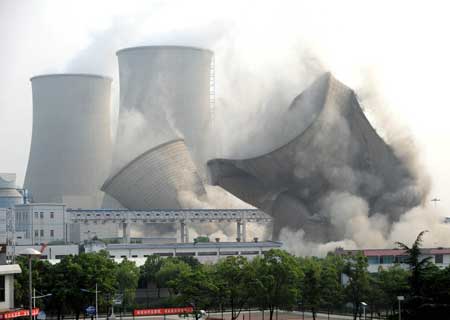 In this file photo, two 90-m-high cooling towers collapse following a controlled explosion at the Huaneng Changxing Power Plant in Changxing county, Zhejiang province, on September 16, 2010. The plant shut down two outdated electric generating sets in order to reduce coal consumption and waste emission in August. [File/Xinhua]
|
"The targets surely need to be handed over to local governments, and a specialized blueprint for cutting greenhouse-gas emissions is a necessity," Su Wei, director-general of the Department of Climate Change of the NDRC, told China Daily.
According to a draft plan released in January, the areas will be divided into five types with various energy intensity reduction goals ranging from 10 percent to 18 percent.
The target is a step in the government's pledge to cut carbon intensity by 40 to 45 percent from 2005 levels by 2020.
The NDRC has also begun working out ways to attain further, large-scale reductions of carbon dioxide emissions after 2020.
Xie said that China considers carbon capture and storage (CCS) an important technical means of reducing carbon dioxide emissions in the next few decades, and that the country should already be working toward the development of the emerging technology.
CCS development faces great uncertainties worldwide because of the high costs and safety concerns, and several projects in developed countries were halted last year.
Despite the challenges, China won't rule out CCS as a key technical option in the future, but its use will depend on its competitiveness and the global demands for emissions reduction, he added.
Xie called for international collaboration in research and technology transfers from developed countries.
China has set targets to boost its non-fossil-fuel use to 15 percent of energy consumption by 2020, and many obsolete and inefficient coal-fired power plants have been closed.
However, coal remains the primary source of energy in China, the world's largest consumer of coal, with more than 70 percent of the country's energy consumption depending on it.
Foreign companies count on China to take a leading role in the commercialization of CCS, but according to Su, China sees CCS mainly as a means of reducing carbon dioxide after 2020 and 2030.