Economy
Organic food a growing biz for the health-aware
By Li Woke (China Daily)
Updated: 2011-06-27 10:51
 |
Large Medium Small |
|
 |
|
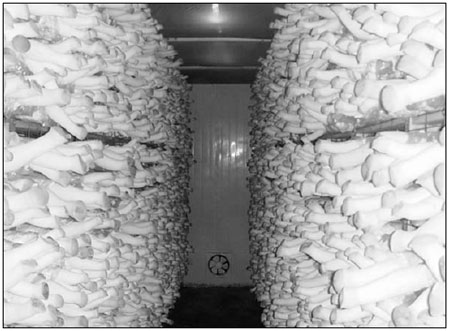
A mushroom growing room in the Beijing Leading Green Food Co Ltd in Tongzhou District, Beijing. The mushrooms are produced without synthetic pesticides, chemical fertilizers or chemical food additives, and are not genetically modified, the company said. [Photo / Provided to China Daily] |
BEIJING - Xu Lei, a 33-year-old stay-at-home mother, decided to go organic by planting her own fruit and vegetables inside her apartment in downtown Beijing. She is now able to harvest a variety of produce, including tomatoes, beans, cucumbers, pumpkins and potatoes.
"I hope my husband and my little daughter can eat more healthily by planting our own dinner table food," said Xu. "Of course, if these vegetables are not sufficient for our family, then I will go to supermarkets for more organic food."
Organic food is produced using methods that do not involve modern synthetic inputs such as synthetic pesticides and chemical fertilizers, are not genetically modified, and are not processed using irradiation, industrial solvents, or chemical food additives.
In recent years, China has witnessed a surge in organic farming among ordinary people who advocate the use of traditional farming methods without the use of artificial fertilizers or pesticides. Many white-collar workers who live in downtown Beijing even travel to the suburbs, rent a plot of land and cultivate their own vegetables and fruit, spending weekends toiling over the soil.
"Organic food has become more and more popular in recent years," said a saleswoman called Wang at a Beijing Ito Yokado Store, which supplies a range of organic food from Xiaotangshan in Beijing's Changping district. "Sales of organic food are especially good during the weekend when people stay at home and have the time to cook their own meals."
|
||||


The Chinese consumers are now believed to consume more than twice as much organic food as health-conscious Japan. The Chinese government statistics show the market is worth about 10 billion yuan ($1.55 billion), having quadrupled over the past five years.
The booming demand has driven many companies to try to corner the market. Beijing Leading Green Food Co Ltd is one of them.
An oasis in a Beijing suburb, the organic food company covers an area of 8.67 hectares, which is full of organic mushrooms.
"We invested 115 million yuan in the company and made a 20 percent net profit by selling mushrooms," said Li Dajiang, board chairman of Beijing Leading Green Food.
The company's annual output has reached 5 million kilograms, and sales revenue of the company is now 100 million yuan annually, Li said.
Most of the company's organic food goes to supermarkets in Beijing, Tianjin, Shenyang and Shijiazhuang. But "if demand of organic mushrooms continue to climb at home and abroad, we will consider doing business overseas, of course".
According to the China Organic Food Certification Center, a top organic food certification agency under the Ministry of Agriculture, the country's organic exports totaled $350 million in 2006 (the most recent available data), and have continued to surge.
The country now represents 5 percent of global trade in such products. China now ranks third worldwide in organic farmland, after Australia and Argentina, up from 45th in 2000.
Fueled by the rising demand, an estimated 2 million hectares of farmland are under organic cultivation, while some 1,400 companies and farms have been certified organic.
According to the agency, most of the organic produce are shipped to closer markets such as Japan, Hong Kong, and Taiwan. But organic soybeans, rice and other grains, along with frozen vegetables and fruit concentrate, also travel to the US and European markets.
Scholars believe that exports are the main driving engine behind the sector's growth. But Li from Beijing Leading Organic Food thinks the domestic market is playing a key role.
"Most of my counterparts and friends' orders come from Chinese retailers, and I believe the prosperity in the 'green' food industry will stay robust over the next decades."
| 分享按鈕 |